Frequently Asked Questions
How far is your Cleveland clinic from Delano, TN?
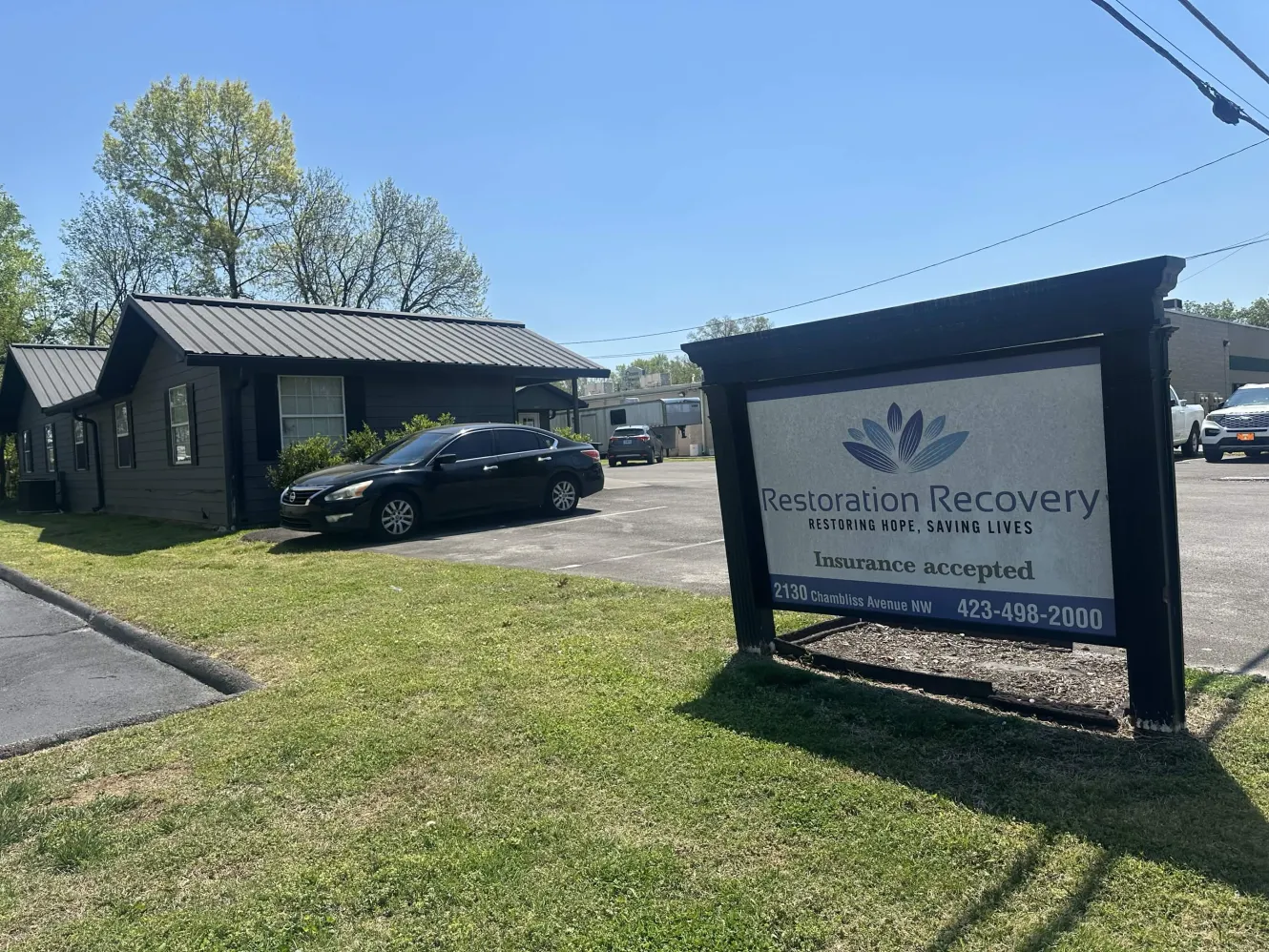
About 30 minutes west. From the US-411 / TN-30 / TN-163 junction in Delano you take US-411 north-west toward Etowah, then south-west on US-411 through Ocoee and into Cleveland, and east on 25th Street NW to 2130 Chambliss Avenue NW. Figure 28 to 35 minutes depending on weather and Ocoee rafting-season traffic. Homes east of US-411 on Spring Creek Road, Gee Creek Road, or up into the Cherokee National Forest add a couple of minutes on the front end.
Is there a closer clinic than Cleveland for Delano residents?
Cleveland is the closest Restoration Recovery clinic. We do not have a location inside Polk County itself, and given Delano's population (well under 1,000 residents) and Polk County's total of about 17,500 across 439 square miles of mostly national forest and mountain terrain, there is no realistic patient volume to support an in-county clinic. The practical alternative is the model we already run: a first in-person visit at Cleveland, plus telehealth follow-ups for most subsequent visits. After that first visit, Delano-area patients on oral medication do not have to make the 60-mile round trip unless their provider asks them to come in, and patients on a long-acting injection make it for each injection.
Polk County is small — are there even reliable drug statistics for Delano?
County-level exact overdose counts for Polk County are often suppressed in Tennessee Department of Health reports, because publishing precise numbers in communities this small creates a re-identification risk for individual families. The honest way to describe the local picture is regional: East Tennessee accounts for roughly 43% of Tennessee's overdose deaths (2022), and Appalachian Tennessee overdose mortality runs about 41% higher than the U.S. average (Appalachian Regional Commission data). Polk County sits squarely inside that regional pattern. If someone claims to have a specific Polk County annual overdose-death number down to the individual year, ask where it came from — those numbers are usually reconstructions or small-cell estimates, not published data.
I work the Ocoee rafting season — can MAT actually fit my schedule?
Yes. The combination that works best for guides, outfitter staff, and ancillary rafting jobs is: first in-person visit in the off-season if possible (late fall through early spring), a long-acting injection (Sublocade monthly, or Brixadi weekly or monthly) that removes the daily film / tablet during peak season, and telehealth for everything that is not the injection itself. Once you are stable on a long-acting injection, your in-person clinic footprint drops to as little as one visit a month. Our Cleveland clinic is Tuesday and Thursday, which tends to align well with raft-season shift rotations.
How quickly can I start treatment?
Most Polk County and Delano-area patients are seen within the same week. Call 423-498-2000 or request an appointment online. You leave your first visit with a Suboxone prescription and take your first dose at home (Sublocade and Brixadi injections are ordered during the first visit and administered at a short follow-up). If you are in withdrawal or close to it when you call, we will work hard to get you in the same week.
Will my treatment be confidential in a community this small?
Yes. All treatment at Restoration Recovery is protected by HIPAA and 42 CFR Part 2 — the strictest federal privacy standard for substance use treatment. Your records cannot be shared without your written consent, including with family members, employers, church leadership, or other providers, except in limited cases the law allows, such as a medical emergency or a court order. For a community the size of Delano where privacy concerns are often the single biggest barrier to care, that legal protection matters. The Cleveland location is 30 minutes west of Delano, on the other side of Polk County's western edge — far enough that bumping into a neighbor in our waiting room is effectively impossible.
What insurance do you accept?
We accept TennCare (the most common coverage in rural East TN), Medicaid, BlueCross BlueShield of Tennessee, Cigna, Aetna, Ambetter, United Healthcare, and most major commercial plans. What you pay depends on your plan. Check your coverage here or call to verify before your first visit.
Do I need to stop using opioids before my first appointment?
You do not need to be completely off opioids before coming in. Your provider will evaluate where you are and guide you through a safe transition onto Suboxone. In most cases, you should be in early withdrawal (usually 12–24 hours since last use of short-acting opioids, longer for long-acting opioids) before your first dose — your provider will explain exactly what to expect and when to take it at home.
Can I do follow-up appointments from home?
Yes. After your initial in-person evaluation, most follow-up visits can be conducted via secure, HIPAA-compliant telehealth from your phone, tablet, or computer. For Delano residents, this is usually what makes long-term treatment sustainable. Cell signal along the Hiwassee and inside the Cherokee National Forest boundary is spotty in places, so you may want to join from home over Wi-Fi or from a spot with better signal. The only appointments that have to happen in person after intake are the long-acting injections (Sublocade and Vivitrol every four weeks, Brixadi weekly or monthly) and any visit your provider asks you to come in for.


 CARF Accredited