Restoration Recovery outpatient addiction treatment logo
Near Englewood, TN · McMinn County · 37329

Addiction Treatment Near Englewood, TN

For the roughly 1,600 residents of Englewood — the old Eureka Mills corner of McMinn County where Niota Street meets Main, the quieter blocks around Oakland Avenue, and the farms that stretch out toward Tellico Plains — Restoration Recovery's Cleveland clinic is about 35 minutes south on US-411. Same-week appointments, Suboxone / Sublocade / Brixadi / Vivitrol, TennCare plus most commercial insurance accepted, and after the first in-person visit we lean hard on telehealth so a 30-mile round trip does not become a weekly obstacle.

CARF CARF Accredited Accepting New Patients Same-Week Appointments Most Insurance Accepted Telehealth Available
The Englewood Picture

What recovery looks like from a rural McMinn County town

Englewood is a town that most of Tennessee drives past without noticing. Tucked between Etowah and Madisonville on US-411, the population sits around 1,600 — roughly the same as it was a hundred years ago when the Eureka Cotton Mills and the later Englewood Manufacturing Company hosiery plant were the economic engine of the place. The mills are gone; the last one, Allied Hosiery, closed its doors in 2008. What is left is a compact downtown on Niota Street, the Englewood Textile Museum that keeps the memory of the mill-town women alive, a few hundred houses, and a lot of families who have been here for four, five, six generations. When you live in a town this size, going to the doctor is never just a medical decision — it is a community decision, and that is part of why people put off treatment for years.

The patients we see most often from Englewood are not strangers to work or to hardship. They are farmers, small-engine mechanics, school-bus drivers, retail clerks at the grocery up the road, nurses at the Etowah or Sweetwater hospitals, and tradespeople who drive up to 45 minutes one way to a jobsite in Athens, Madisonville, or Knoxville. A lot of them started on a legitimate prescription for hydrocodone or Percocet after a work injury, a surgery, or a fall, and never quite came off. Some have been cycling between pain clinics, urgent cares, and the occasional ER visit for a decade. What almost all of them share is that residential rehab has never been realistic — the drive is too far, the time off work is too expensive, and the idea of leaving the house and the family for 28 days does not match the lives they actually live. Outpatient medication-assisted treatment was built for exactly these circumstances.

McMinn County drug overdose deaths

2023 calendar year, opioid share

27 All drug ODs
17 Opioid-involved ~63% of all

Source: Tennessee Department of Health, 2023 Tennessee Drug Overdose Death Report.

East Tennessee’s share of state ODs

Tennessee overdose deaths by region, 2022

3,826 Statewide
~43% East TN Highest in state

Source: TN Department of Health; East TN includes McMinn and the surrounding rural counties.

What the numbers mean for a town of 1,600

McMinn County recorded 27 drug overdose deaths in 2023, with 17 of those involving opioids — roughly two-thirds. In a county of about 54,000 people, that is a rate higher than the national average, and it sits inside a region that the Tennessee Department of Health has identified as the state's most overdose-burdened. East Tennessee accounted for roughly 43% of all Tennessee drug overdose deaths in 2022, the highest share of any region in the state.

For a town the size of Englewood, those numbers land differently than they do in a city. You almost certainly know a household that has lost someone. You may have attended the funeral. The stigma around addiction is real here, and it tends to keep people from asking for help in their own ZIP code. That is part of the reason we structure care for Englewood patients the way we do: one in-person intake at our Cleveland clinic 35 minutes south, then telehealth for most of what follows, so that treatment does not turn into a recurring public errand inside a small town where everyone recognizes everyone's truck.

If you or someone in your family has been revived with Narcan in the last year — or narrowly avoided needing it — a first appointment is almost always the right next step. We do not require abstinence before you come in, and we do not require you to have tried anything else first.

Nearest Location · 35 min from Englewood

Cleveland Clinic

Address2130 Chambliss Avenue NW
Cleveland, TN 37311
HoursTuesday & Thursday · 9:00 am – 4:30 pm
Fax423-498-2001
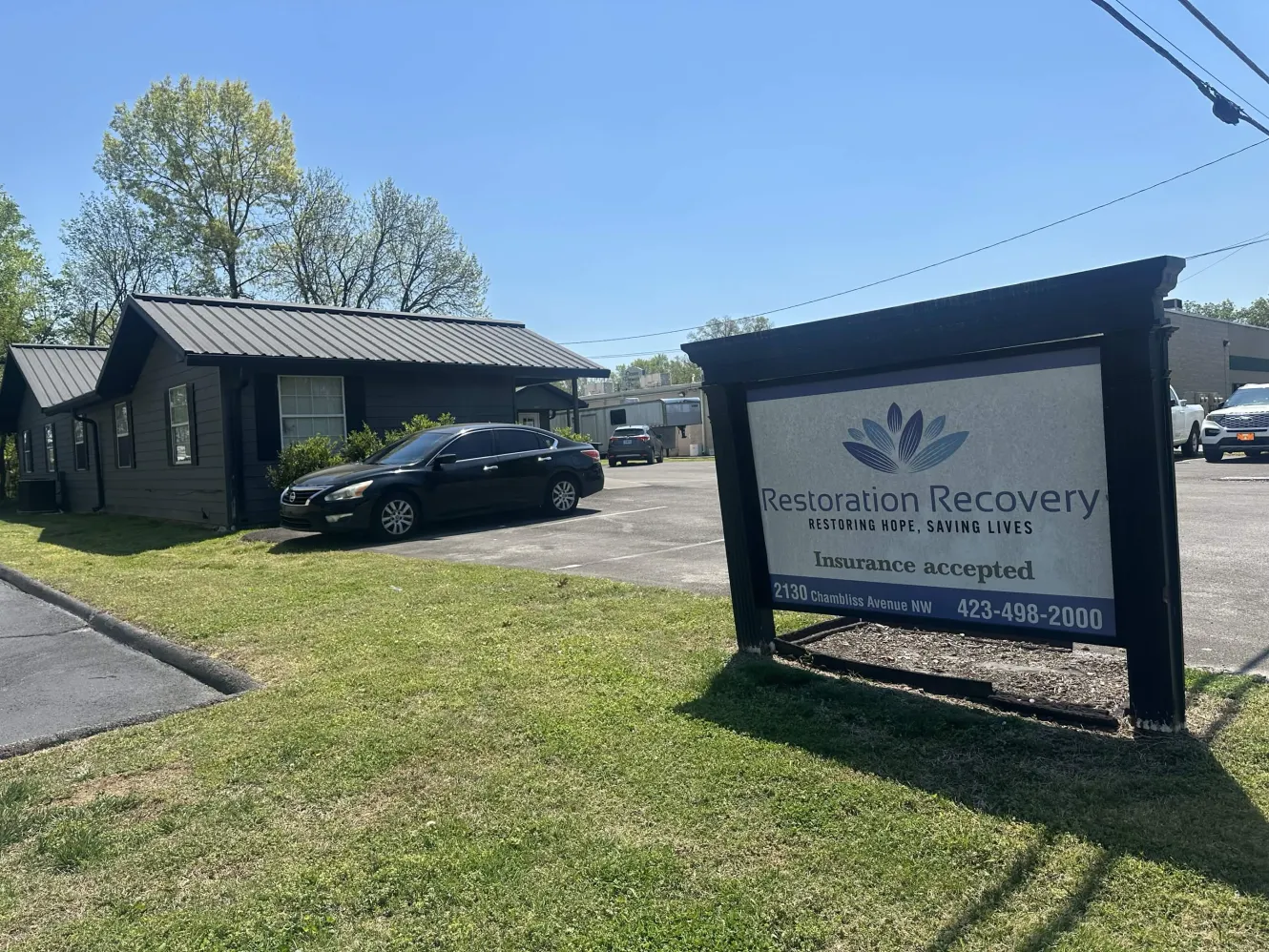
Restoration Recovery Cleveland clinic near Englewood, TN
From small-town Englewood

The drive south on US-411 — and why telehealth makes most of it unnecessary

Englewood is too small to need a neighborhood-by-neighborhood breakdown. The town's entire footprint is about 1.7 square miles, and for practically everyone in the 37329 ZIP the drive out of town for treatment looks the same: south on US-411 through Etowah, Benton, and into Cleveland. What changes is not the route — it is how often you have to make it. For an Englewood patient, the goal of our scheduling is to get that in-person drive down to once every four to twelve weeks after the first visit. Everything in between runs on a phone screen or a laptop from your kitchen table.

The US-411 south route to the Cleveland clinic

From downtown Englewood, you get on US-411 south. The highway runs through Etowah (the old L&N railroad town, about 10 minutes down), continues south through Benton in Polk County (about 20 minutes), and then crosses into Bradley County and merges with traffic on the Cleveland side. Total drive to 2130 Chambliss Avenue NW in Cleveland is roughly 30 miles and 35 minutes in light traffic, a little more in the summer when travelers from Atlanta are cutting through on their way to the Ocoee River. The route is almost entirely on a single US highway, which matters in bad weather — no back-road shortcuts to second-guess, no interstate merges, no tunnel through a mountain. It is the kind of drive a patient who has just started Suboxone can handle even on their first week of treatment, when their concentration is not yet back to normal.

Why we steer Englewood patients toward telehealth

A 35-minute one-way drive is fine once. It is not fine twice a week for a year. For a rural patient, weekly in-person visits are how treatment fails — a tractor breaks down, a kid gets the flu, gas is $3.75 a gallon, and suddenly the appointment gets rescheduled, then rescheduled again, then skipped. We know the pattern, and it is not a willpower problem. So we front-load the in-person work. Your first visit to the Cleveland clinic is the intake: DSM-5 assessment, COWS score if you are coming in for opioid use disorder, a counseling session, and a doctor evaluation. In most cases you leave with a Suboxone prescription that same day. After that, the clinic calendar shifts: most medication management follow-ups can be done via HIPAA-compliant telehealth from your phone or computer in Englewood. The only visits that have to be in-person are injection days for Sublocade, Brixadi, or Vivitrol, which are monthly (or longer) by design.

What telehealth looks like for a rural patient

In practical terms: a 15 to 30 minute video call with your provider on a schedule that matches your life. It does not require fancy hardware — any smartphone made in the last eight years will do. It does not require home internet if you have cellular data. We have Englewood and Tellico Plains patients who do their follow-ups from the cab of a truck parked in a field, from the break room of a plant in Athens, or from their own couch after the kids are in bed. The only part that cannot be done remotely is the controlled-substance conversation at certain milestones, which federal regulations still require in-person roughly once a year for long-term maintenance patients. Even that single visit is usually an hour-and-a-half round trip from Englewood, not a full day out of work.

When the drive is worth making

A few situations are worth the in-person drive to Cleveland even when telehealth would be allowed: the first intake, any time your dose is being significantly changed, an injection visit, and the annual check-in. If you already have a trip to Cleveland or Chattanooga on your calendar for something else — a shopping run to a big-box store, a visit to a specialist at the Tennova or Parkridge systems, a family member at CBL — stacking the clinic appointment on the same day makes the math painless. Several of our Englewood patients specifically book their Sublocade injection for the same Tuesday or Thursday they already planned to be in Cleveland for groceries.

If transportation is a real problem

Ask before you assume the answer is no. TennCare (BlueCare) plans in McMinn County generally include non-emergency medical transportation (NEMT) that can be used for addiction treatment appointments — you have to call the transportation broker ahead of time, but it works. We can help you figure out the number to call and what to tell them. If you do not have TennCare, the Etowah and Athens area agencies on aging and the McMinn County Transit Service have some ride options, and church networks in the Englewood area have driven more than a few of our patients in the past. We are not going to turn you away because of a transportation problem; we are going to help you solve it once.

How Treatment Works

Restoration Recovery provides outpatient addiction treatment — no residential stay, no detox facility. You visit our Cleveland clinic for appointments and go home the same day. Treatment is built around your schedule, not the other way around.

Your first visit typically takes 60 to 120 minutes and follows a four-step flow: intake (DSM-5 assessment + COWS score for opioid use disorder), counseling, a doctor evaluation, and — if clinically appropriate — a same-day Suboxone prescription (Sublocade and Brixadi injections are ordered per-patient and administered at a follow-up visit). Follow-up visits are shorter and can often be done via telehealth from home.

What We Treat

We provide evidence-based treatment for addiction to opioids and opioid-like substances including heroin, fentanyl, oxycodone (OxyContin, Percocet), hydrocodone (Vicodin, Norco), morphine, codeine, tramadol, and prescription painkillers.

We also treat alcohol use disorder, stimulant dependence (cocaine, methamphetamine, Adderall, Ritalin, Vyvanse), benzodiazepine dependence (Xanax, Klonopin, Ativan, Valium), cannabis use disorder, and co-occurring mental health conditions including anxiety, depression, and trauma.

Kratom & 7-Hydroxymitragynine (7-OH) Addiction

Kratom and its concentrated derivative 7-OH are increasingly available and can cause opioid-like physical dependence with severe withdrawal symptoms. Our providers have experience treating kratom and 7-OH dependence with MAT and clinical support tailored to its distinct withdrawal profile. If you are struggling with kratom or 7-OH products, we can help.

Medications We Prescribe

  • Suboxone (buprenorphine/naloxone) — daily film or tablet for opioid use disorder. Reduces cravings and prevents withdrawal so you can function normally.
  • Sublocade (extended-release buprenorphine) — once-monthly injection for patients who prefer not to take daily medication. No pills, no films, no daily decisions.
  • Brixadi (extended-release buprenorphine) — weekly, bi-weekly, or monthly injection for opioid use disorder. Flexible dosing intervals for patients who want a shorter cadence than monthly, or who are still titrating to a maintenance dose.
  • Vivitrol (naltrexone) — once-monthly injection for alcohol use disorder. Blocks the reward pathway that drives compulsive drinking.

Insurance & Cost

We accept most major insurance plans including TennCare, Medicaid, BlueCross BlueShield, Cigna, Aetna, Ambetter, and United Healthcare. Most patients pay little to nothing out of pocket. Verify your coverage or call 423-498-2000 before your first visit.

Why Choose Restoration Recovery

  • CARF accredited (Commission on Accreditation of Rehabilitation Facilities)
  • Licensed in Tennessee and Georgia
  • HIPAA and 42 CFR Part 2 compliant — your treatment is confidential
  • MAT-certified providers
  • Four clinic locations with same-week appointments
  • Telehealth available for follow-up care from home
  • Integrated hepatitis C treatment for enrolled patients
Why Englewood residents come to us

What we see most often from 37329 patients

The mill-town inheritance

Englewood's identity was shaped by more than 150 years of textile manufacturing, from the Eureka Cotton Mills in 1857 through the Englewood Manufacturing Company hosiery plant and eventually Allied Hosiery, which closed in 2008. The mills built a particular kind of community: multi-generational, female-heavy in the workforce, with a strong sense that you took care of your own and you did not air your troubles to outsiders. That cultural muscle memory is still here, and it is part of why we do not ask for a lot of explaining when a patient from Englewood walks in. Your first appointment is not the place to justify yourself — it is a medical visit. You tell us what you are using, how often, and for how long; we handle the rest. We are not going to pretend that a small town in rural Tennessee is the same as a suburb outside Nashville, and our approach reflects that.

The rural pain-and-prescription pathway

Rural East Tennessee has one of the highest opioid prescribing rates in the country, and Englewood sits squarely inside that pattern. A lot of our patients from the 37329 ZIP came to us through an injury-and-prescription path: a farm accident, a car wreck on the curvy stretch of 411 south of town, a work injury at a fabrication plant in Athens, a fall off a roof. The prescription worked. When it ran out, the body had already adapted, and what came next was either a slow taper that did not take, a switch to street pills, or a migration to something cheaper and stronger. We are not here to argue about how someone ended up where they are — we are here to help them get off that treadmill. Buprenorphine at the right dose eliminates the physical withdrawal and the craving, and the rest of the conversation — including the original pain that started everything — becomes possible again.

The "nearest real option is a drive" problem

This is honest: there is no full-service outpatient addiction clinic inside Englewood. The nearest ones are in Athens (~15 minutes north), Etowah (~10 minutes south), and Cleveland (~35 minutes south). We are Cleveland. That is a structural fact about rural East Tennessee, not a Restoration Recovery problem — the UTK-led East Tennessee Rural Health Consortium has flagged exactly this issue, that rural counties tend to have only one or two treatment sites and those sites fill up with waiting lists. We do not have waiting lists for new intake. Most Englewood-area patients are seen within the same week they call, usually on a Tuesday or Thursday when the Cleveland clinic is staffed, and the rest of your care shifts to telehealth so you are not driving 35 minutes each way over and over.

The older rural Southern patient

A meaningful share of the Englewood patients we see are over 55. They were on opioids prescribed by a family doctor for a back, a knee, a shoulder, or a hip for the better part of a decade. When the prescribing practice got tightened up — locally because of a practice change, state-wide because of the 2018 Tennessee prescription limits, or nationally because a provider retired — they were left in withdrawal with a problem nobody had explained to them. That group tends to be skeptical of addiction treatment because the language does not match their experience; nobody thinks of themselves as an addict when they followed doctor's orders for 10 years. We do not push the label. We ask about physical dependence, we address the withdrawal, and we use the appropriate medication. For patients in this group, a monthly Sublocade injection often works better than daily Suboxone films, because it takes the daily decision-making out of the picture entirely.

The family-on-the-rescue patient

Because Englewood is a town where families tend to stay for generations, our referrals often come from adult children or spouses who have been quietly watching someone's use escalate. The first call to our clinic is just as likely to come from a daughter in Knoxville as from the patient themselves. We talk to families; we do not tell them what their person is doing in treatment, but we can tell them generally what to expect, how to support a first visit, and what resources are available if the person is not ready yet. Narcan — available for free from the Tennessee Department of Health — is worth having in the house regardless. A prior overdose reversal is not a disqualifier for insurance and is actually one of the clearest clinical reasons to start MAT quickly.

The privacy calculus in a small town

This comes up in almost every first appointment from Englewood. The question is never said directly, but what is being asked is: "Who is going to see me walk into this building?" The answer for our Cleveland clinic is: not anyone from your corner of Englewood, almost certainly. Cleveland is a city of about 48,000 people, we are on Chambliss Avenue which is nowhere near a normal Englewood errand, and we are 30 miles from home. Your treatment is also protected by HIPAA and 42 CFR Part 2, the strictest federal privacy standard for substance use records. Nothing can be released to a family member, employer, church, or another provider without your written consent. If a neighbor calls asking whether you are a patient, the staff cannot confirm or deny — not even to someone who claims to be your spouse. This matters in Englewood.

Telehealth as the long-term answer for a rural patient

Once you are stable on medication, most of your care can run from home. Our Englewood-area patients typically do one in-person visit every one to three months (injection, dose change, or the annual in-person required for controlled-substance continuity) and handle everything else by secure video call. For a rural patient, that is what makes treatment sustainable past the first few months. It is also what makes it possible to start treatment at all for people whose transportation is unreliable, who share one vehicle with a partner, or who work hours that do not overlap with weekday clinic availability.

Frequently Asked Questions

How far is your Cleveland clinic from Englewood?

About 35 minutes. From downtown Englewood, take US-411 south through Etowah (the old L&N railroad town, around 10 minutes down) and Benton (about 20 minutes) and continue into Cleveland. Our clinic is at 2130 Chambliss Avenue NW, Cleveland, TN 37311. The full drive is approximately 30 miles and stays on a single US highway the whole way, which makes it predictable even in bad weather.

Can I really do most of my treatment by telehealth from Englewood?

Yes, and for a rural patient we actively encourage it. After the first in-person intake at our Cleveland clinic, most medication management follow-ups can be handled by secure video call. The visits that must stay in-person are injection days for Sublocade, Brixadi, or Vivitrol, and periodic in-person check-ins required by federal rules for long-term controlled-substance care. Typical Englewood cadence after the first visit is one drive to Cleveland every four to twelve weeks, everything else online.

What if I cannot afford the gas or the drive?

Ask us before you rule it out. Many TennCare (BlueCare) plans in McMinn County include non-emergency medical transportation that can be booked for addiction treatment appointments — you call the transportation broker listed on the back of your insurance card. McMinn County Transit Service and some area church networks also provide rides for medical appointments. And because we move most of your care to telehealth after the first visit, the transportation problem really only has to be solved one or two times at the start.

I live in a town where everyone knows each other — will my treatment stay private?

Yes. All treatment is protected by HIPAA and 42 CFR Part 2, the strictest federal privacy standard for substance use records. Nothing can be shared with family, employers, churches, or other providers without your written consent. Our clinic is in Cleveland, 35 minutes and 30 miles south of Englewood, which is far enough that you are very unlikely to run into anyone from home in our waiting room. The staff is also trained not to confirm or deny whether someone is a patient, even to a caller claiming to be a family member.

How quickly can I start treatment?

Most Englewood-area patients are seen within the same week they call. Our Cleveland clinic runs Tuesdays and Thursdays, 9 am to 4:30 pm. Call 423-498-2000 or request an appointment online and we will work your intake into the first available Tuesday or Thursday slot. Many patients begin Suboxone on their first visit.

What insurance do you accept?

We accept TennCare (BlueCare is widely used in McMinn County), Medicaid, BlueCross BlueShield of Tennessee, Cigna, Aetna, Ambetter, United Healthcare, and most major commercial plans. Most Englewood patients pay little to nothing out of pocket. Check your coverage here or call to verify before your first visit.

Do I need to stop using opioids before my first appointment?

You do not need to be completely off opioids before coming in. Your provider will evaluate where you are and guide you through a safe transition onto Suboxone. In most cases, you should be in early withdrawal (usually 12 to 24 hours since last use of short-acting opioids, longer for methadone or fentanyl) before your first dose — your provider will explain exactly what to expect and time the first appointment accordingly.

Can my family come with me to the first visit?

Yes. Many rural Tennessee patients bring a spouse, adult child, or parent to the first intake, and we encourage it. Your family member can sit in on the parts of the visit where you want them, and step out for the medical assessment if you prefer privacy. They cannot receive information about your care later without your written consent, but being at the first appointment often helps them understand what treatment looks like and what their role is at home.

Other Restoration Recovery Locations

In addition to our Cleveland clinic, Restoration Recovery operates three other outpatient locations across Tennessee and Georgia.

  • Chattanooga, TN — 6141 Shallowford Rd, Suite 100, Chattanooga, TN 37421 (Mon–Fri, 9am–4:30pm)
  • Soddy-Daisy, TN — 210 Walmart Drive, Suite 100, Soddy-Daisy, TN 37379 (Mon & Wed, 9am–4:30pm)
  • Ringgold, GA — 4962 Battlefield Pkwy, Ringgold, GA 30736 (Fri, 9am–4:30pm)

View all locations →

Resources

Also serving: Athens, Benton, Etowah, Sweetwater

A place for hope & healing

Starting is the
hardest part.
We’ll take it from there.

Same-day appointments available in most cases. Confidential from your first call.