Restoration Recovery outpatient addiction treatment logo
Near Monteagle, TN · 37356 · Grundy County

Addiction Treatment Near Monteagle, TN

For the roughly 1,200 residents of Monteagle, the summer families at the Sunday School Assembly, the Sewanee-adjacent community up on the plateau, and the wider Grundy County population spread across Tracy City, Coalmont, Altamont, Gruetli-Laager, and Beersheba Springs, our Chattanooga clinic on Shallowford Road is about 50 minutes down I-24 East — one straight run off the Cumberland Plateau, down Monteagle Mountain, through the Sequatchie Valley, and into Hamilton County. Same-week appointments. Suboxone, Sublocade, Brixadi, and Vivitrol. TennCare plus most commercial insurance. After the first in-person visit, telehealth carries the bulk of ongoing care so you do not have to make the drive down the mountain every week.

CARF CARF Accredited Accepting New Patients Same-Week Appointments Most Insurance Accepted Telehealth Available
The Monteagle Picture

What recovery looks like from the top of the plateau

If you live in Monteagle — on the Assembly grounds, along Dixie Lee Avenue, out toward the overlook, up on Laurel Lake Drive, or in any of the cottage lanes where the Sunday School Assembly has sat since 1883 — or anywhere in the wider Grundy County footprint, you already know what mountain healthcare looks like. The nearest full-service hospital is not in the county. The nearest specialty outpatient clinic for medication-assisted treatment (MAT) is ours, 50 minutes down I-24 East in Chattanooga. You know the drive: past the truck-inspection station, down the eastbound 6% grade, through Kimball and Jasper, across the Tennessee River, and into Hamilton County. Most people we see from the 37356 ZIP have made that drive a thousand times for work, groceries, or a doctor's appointment that could not be handled on the plateau. A first visit with us is one more run down the mountain; after that, telehealth carries the rest.

The patients we see most often from Monteagle and Grundy County are not the stereotype people imagine when they hear "opioid addiction." They are retired coal miners, construction workers, loggers, landscape crews, housekeepers from the Assembly cottages, kitchen and grounds staff from Sewanee, truckers who run the Monteagle pass every week, grandparents raising grandchildren, and middle-aged plateau residents who got hurt at work and never got off the painkillers that followed. A lot of them started on a legitimate prescription a decade or more ago — back injuries from plateau farm work and timber, knee and hip surgery, a serious wreck on US-41A or out on the Beersheba curves, a work injury in the mines before the last ones closed. When the prescriptions got cut off, the withdrawal and the cravings did not. What almost all of them tell us at the first visit is some version of the same sentence: "I never thought this was going to be me. I just needed to keep working."

Grundy County context

Poverty, coverage & prescribing indicators

18.8% Uninsured
10.9% TN avg uninsured
~2x Grundy vs state nearly double the rate

Source: Sycamore Institute analysis of American Community Survey data. Grundy County's uninsured rate is nearly twice the Tennessee statewide average, and 14.9% of Grundy families live below the federal poverty line. These are the structural reasons MAT access has historically been hard to reach from the plateau.

Tennessee overdose deaths trend

Statewide annual totals

3,826 2022
3,616 2023
77% Fentanyl share first YoY decline since 2013

Source: Tennessee Department of Health 2023 Drug Overdose Death Report. Fentanyl and other synthetic opioids were involved in 77% of 2023 Tennessee overdose deaths. The 2023 total marked the first YoY decline since statewide overdose tracking began in 2013.

Why the Grundy County numbers matter on the plateau

Grundy County has been called the poorest county in Tennessee at several points in the past two decades. The headline number changes year to year, but the structural picture has not: a 14.9% family poverty rate, an uninsured rate roughly twice the Tennessee average, a median household income that trails the state by a wide margin, and a workforce that still leans on physically demanding trades — trucking, construction, timber, service work tied to the Assembly and Sewanee, and whatever is left of the coal and manufacturing base that built Tracy City and Palmer in the twentieth century.

Two things follow from those numbers. First, a decade of higher-than-average opioid prescribing across rural Tennessee (the state averaged more than 61 prescriptions per 100 residents in 2022, well above the national rate) left a legacy-dependence cohort in Grundy County that is still working through the aftermath today. The pills are mostly gone from the pharmacies; the dependence they created is not. Second, the uninsured gap means that for years, a lot of Grundy residents who wanted help could not afford to walk into a specialty clinic. TennCare expansion, sliding-scale access, and telehealth have shifted that equation over the past few years, but the word has not fully caught up with the reality.

The statewide picture is also shifting fast. Tennessee overdose deaths dropped for the first time in a decade in 2023, driven by naloxone saturation, a shift in the street fentanyl supply, and more people moving from active use into treatment. That is the conversation we are set up to have. If you have been carrying a quiet dependence for five years, ten years, fifteen years, you are not alone up there, and the door into treatment is lower now than it has ever been.

Nearest Location · ~50 min from Monteagle

Chattanooga Clinic

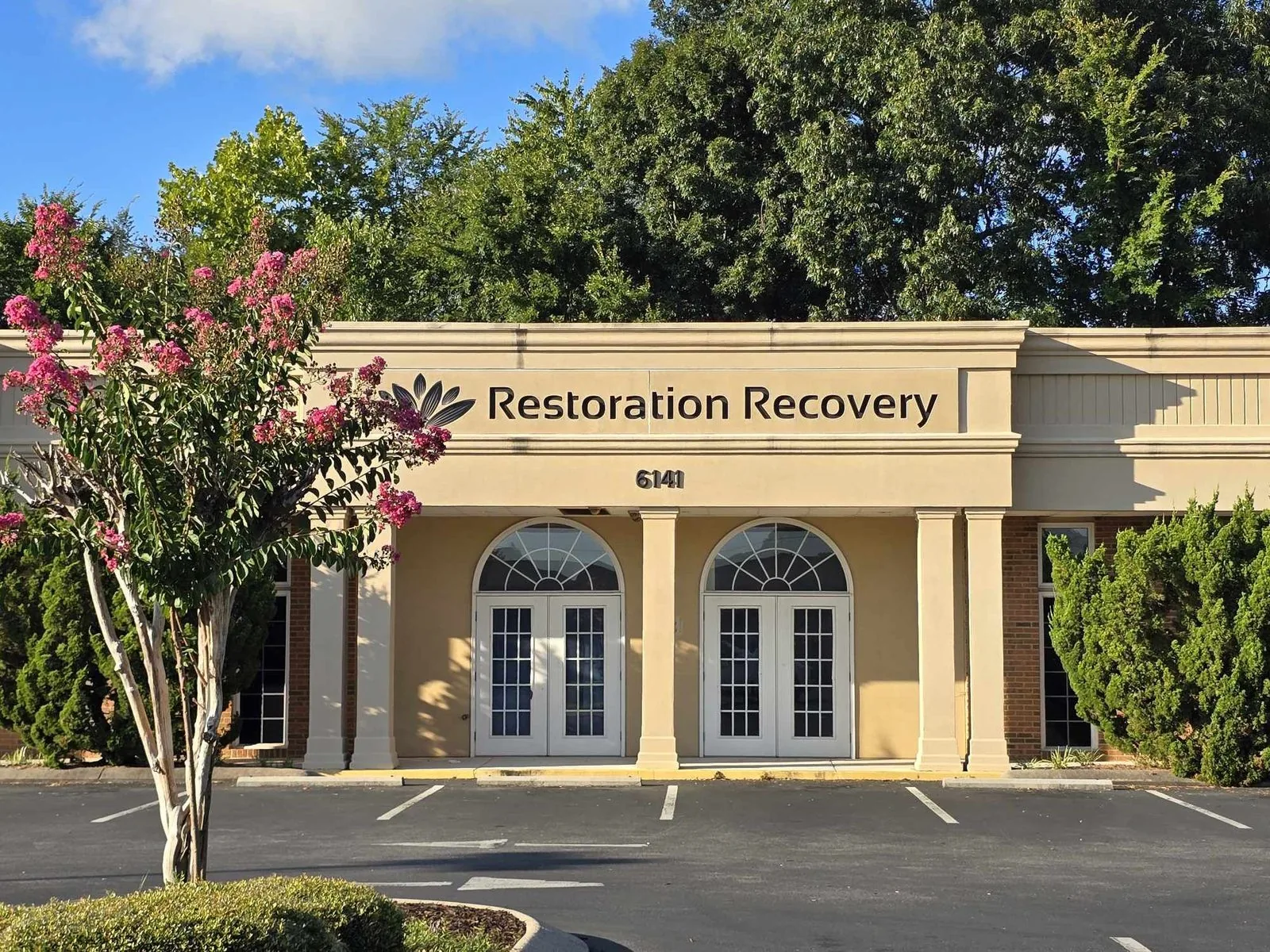
Address6141 Shallowford Rd, Suite 100
Chattanooga, TN 37421
HoursMonday – Friday · 9:00 am – 4:30 pm
Fax423-498-2001
Restoration Recovery Chattanooga clinic near Monteagle, TN
From the Mountain

Getting off the plateau, down I-24 East, and into clinic

Monteagle sits on top of the Cumberland Plateau at about 1,900 feet, almost exactly halfway between Nashville and Chattanooga. Almost every trip to our clinic starts the same way: I-24 East at one of the Monteagle exits, then a straight run across the plateau before you hit the eastern rim and start the descent off Monteagle Mountain toward Kimball and the Sequatchie Valley. The drive is roughly 50 minutes in clear weather from the Monteagle town line to our Chattanooga clinic at Shallowford Road. What changes by neighborhood is the first five minutes of the drive, and in winter, what changes is whether you should be making the drive at all.

Monteagle town & the Assembly grounds

If you live in Monteagle proper — on the Assembly grounds, along Main Street, out by the Monteagle Inn, on Dixie Lee Avenue, or in the cottage lanes that fan off the Assembly gate — the route is short and obvious. US-41A south to I-24 East at Exit 134 or Exit 135, then follow the interstate down the mountain and east through Jasper, Haletown, and into Hamilton County. Clean dry weather, it is about 50 minutes to the clinic. In morning fog, add 15 minutes and expect a slower pace down the descent. The truck-inspection station at the top of the eastbound grade is a good landmark; once you are past it, you are committed to the downhill run.

The I-24 infrastructure — truck stops, fuel, and the pass itself

Monteagle Mountain is one of the most trucked-over passes in the southeastern United States. The town is built around that reality: Pilot, Love's, and the older Monteagle truck-stop cluster at Exits 134 and 135 stay open 24 hours, and the mountain itself is a steady stream of loaded trailers pulling up the westbound grade and grinding down the eastbound one. If you are a driver who lives on the plateau and runs freight through the pass for a living — or who works the truck-stop restaurants, fuel islands, and housekeeping shifts that keep the infrastructure running — your schedule likely already has you moving through the Monteagle corridor daily. The Chattanooga clinic sits directly off I-24 East at Exit 4 (Shallowford Road), which means for many truckers and truck-stop workers, the clinic is genuinely on the route. A 9 am first-visit slot before the afternoon shift, or a late-morning slot before a turn-and-burn run down to Atlanta, fits most schedules.

The eastbound descent — what the drive actually feels like

The eastbound I-24 descent off Monteagle Mountain drops about 1,161 feet over 4.1 miles at a sustained 6% grade, which makes it one of the steeper interstate descents in the eastern United States. For a passenger vehicle in dry weather, it is a six-minute descent with little drama. For a loaded truck or an unfamiliar driver in fog or ice, it is the segment that Johnny Cash and Jerry Reed built songs around, and the two runaway truck ramps on the descent are not ornamental. If you are driving down the mountain for a first visit and you are uncomfortable with the grade, take it in the right lane, use engine braking, and plan for an extra cushion of time. We have never had a patient arrive late to a first visit that we could not accommodate.

Winter weather on the plateau

Winter on the Cumberland Plateau is colder, snowier, and icier than most of the surrounding lowlands. Fog settles on the mountain often enough that TDOT posts variable message signs at the truck-inspection station and along US-41A warning of reduced visibility. Snow and ice events that close I-24 in either direction are rare but not uncommon. The Tennessee Highway Patrol has logged roughly 30 runaway-ramp incidents on Monteagle since 2003, nearly all of them weather-related. For our patients, the working rule is simple: if the eastbound descent is closed or unsafe, do not attempt it. Call us as early as you can and we will either reschedule or, when clinically appropriate, convert your in-person visit to a telehealth appointment. The only visits we cannot do by video are the initial evaluation and the long-acting injection visits (Sublocade and Brixadi). Everything else, including routine medication management, counseling, and check-ins, can happen from your living room while the plow passes on 41A.

The Sewanee and Assembly angle

The University of the South (Sewanee) sits about eight miles west of Monteagle on US-41A, and the Monteagle Sunday School Assembly population swells every summer. Faculty, staff, students, and summer Assembly families who live up on the plateau are all welcome patients. If you are an adult child managing care for a parent who is a cottage owner on the Assembly grounds, or a Sewanee employee who picked up a dependence on painkillers after a surgery and does not want the university health service involved for privacy reasons, our Chattanooga clinic is 50 miles and a ridge away — far enough to give the community separation, close enough that follow-up telehealth keeps the care continuous.

Telehealth as the default after the first visit

For almost every Monteagle patient, the practical model is: one in-person first visit at the Chattanooga clinic, then the large majority of follow-ups by secure video telehealth from home. A 15-to-30-minute medication-management visit does not require 50 minutes down the mountain and 50 minutes back up. DEA rules require the initial evaluation in person for buprenorphine prescribing, and the long-acting injectables (Sublocade, Brixadi, Vivitrol) must be administered at the clinic. Everything else — routine follow-ups, dose adjustments, counseling, most check-ins — is video-capable. Reliable cell service across Grundy County is uneven in pockets, but home Wi-Fi is now common enough on the plateau that most of our Monteagle patients handle the bulk of their care from their own kitchens. If you are unsure whether your connection will hold a video visit, we can do most appointments by phone audio as a fallback.

Serving Monteagle and Grundy County, Tennessee

Restoration Recovery serves Monteagle, the Sunday School Assembly, and the wider Grundy County footprint — Tracy City, Coalmont, Altamont, Gruetli-Laager, Palmer, Beersheba Springs, and the surrounding plateau communities — from our Chattanooga clinic approximately 50 minutes south via I-24 East. Telehealth is strongly recommended for ongoing medication management and counseling after the first in-person visit to reduce travel time for plateau residents.

How Treatment Works

Restoration Recovery provides outpatient addiction treatment — no residential stay, no detox facility. You visit our Chattanooga clinic for the first appointment and go home the same day. Treatment is built around your schedule, not the other way around.

Your first visit typically takes 60 to 120 minutes and follows a four-step flow: intake (DSM-5 assessment + COWS score for opioid use disorder), counseling, a doctor evaluation, and — if clinically appropriate — a same-day Suboxone prescription (Sublocade and Brixadi injections are ordered per-patient and administered at a follow-up visit). Follow-up visits are shorter and, for Monteagle patients, are almost always done via telehealth from home.

What We Treat

We provide evidence-based treatment for addiction to opioids and opioid-like substances including heroin, fentanyl, oxycodone (OxyContin, Percocet), hydrocodone (Vicodin, Norco), morphine, codeine, tramadol, and prescription painkillers.

We also treat alcohol use disorder, stimulant dependence (cocaine, methamphetamine, Adderall, Ritalin, Vyvanse), benzodiazepine dependence (Xanax, Klonopin, Ativan, Valium), cannabis use disorder, and co-occurring mental health conditions including anxiety, depression, and trauma.

Kratom & 7-Hydroxymitragynine (7-OH) Addiction

Kratom and its concentrated derivative 7-OH are increasingly available across rural Tennessee convenience stores, smoke shops, and truck-stop counters — including along the I-24 Monteagle corridor — and can cause opioid-like physical dependence with severe withdrawal symptoms. Our providers have experience treating kratom and 7-OH dependence with MAT and clinical support tailored to its distinct withdrawal profile. If you are struggling with kratom or 7-OH products, we can help.

Medications We Prescribe

  • Suboxone (buprenorphine/naloxone) — daily film or tablet for opioid use disorder. Reduces cravings and prevents withdrawal so you can function normally.
  • Sublocade (extended-release buprenorphine) — once-monthly injection for patients who prefer not to take daily medication. No pills, no films, no daily decisions.
  • Brixadi (extended-release buprenorphine) — weekly, bi-weekly, or monthly injection for opioid use disorder. Flexible dosing intervals for patients who want a shorter cadence than monthly, or who are still titrating to a maintenance dose.
  • Vivitrol (naltrexone) — once-monthly injection for alcohol use disorder. Blocks the reward pathway that drives compulsive drinking.

Insurance & Cost

We accept most major insurance plans including TennCare (BlueCare is the dominant managed-care organization across Grundy County), Medicaid, BlueCross BlueShield, Cigna, Aetna, Ambetter, and United Healthcare. Most patients pay little to nothing out of pocket. For uninsured Grundy County residents, we offer sliding-scale and self-pay options. Verify your coverage or call 423-498-2000 before your first visit.

Why Choose Restoration Recovery

  • CARF accredited (Commission on Accreditation of Rehabilitation Facilities)
  • Licensed in Tennessee and Georgia
  • HIPAA and 42 CFR Part 2 compliant — your treatment is confidential
  • MAT-certified providers
  • Four clinic locations with same-week appointments
  • Telehealth available for follow-up care from home
  • Integrated hepatitis C treatment for enrolled patients
Why Monteagle residents come to us

What we see most often from plateau patients

The year-round plateau community

Most of Monteagle's year-round population works the plateau economy: small-business owners along US-41A, Assembly grounds staff who keep the cottages and the public buildings running across generations of owners, housekeepers and kitchen staff who split time between the Assembly and the Sewanee faculty homes, landscape crews, construction subs building in the Laurel Lake area, and the long-standing Grundy County trades — logging, masonry, HVAC, auto repair, roofing. These are jobs you cannot walk away from for thirty days of residential treatment without losing the work. Our outpatient model is built for that reality. A 60-to-120-minute first visit, a same-day Suboxone prescription in most cases, and then a 15-to-30-minute telehealth cadence that slots around a real work week. We have plateau patients who have never missed a shift since starting treatment.

Summer families and the Assembly cycle

The Monteagle Sunday School Assembly is one of only a handful of surviving Chautauqua-tradition communities in the United States, dating continuously to 1883. Each summer, families that have owned Assembly cottages for two, three, or four generations return for weeks or months on the plateau. That demographic is not the headline picture of opioid dependence, but it is part of our patient mix all the same. A longtime cottage owner who went through a hip replacement, a spouse who has been managing a quiet pain-medication dependence for years, an adult child who came home to help after a parent's diagnosis and found their own prescription habit following them up the mountain. Privacy matters deeply to this group, and so does continuity of care across the summer-to-winter migration. We are set up for both: records protected by HIPAA and 42 CFR Part 2, and a telehealth footprint that follows you from your cottage in July to wherever you winter in December.

Sewanee-adjacent patients

The University of the South is eight miles west on US-41A, and its faculty, staff, and student-age dependents all live inside our plateau service area. For anyone worried about the small size of the Sewanee community and the visibility of the university health service, our Chattanooga clinic offers useful distance. A first visit down the mountain followed by telehealth follow-ups means the care footprint on your local calendar is minimal. We do not coordinate with the university or any employer without your written consent — that is what 42 CFR Part 2 guarantees, and why it exists.

Legacy trades injuries

Grundy County's economic history is a trades history. Coal mining built Tracy City, Palmer, and Whitwell; logging and sawmilling fed the railroads for a century; construction and masonry absorbed most of the next generation; and long-haul trucking — especially the constant flow of freight over Monteagle Mountain on I-24 — still employs a meaningful share of plateau families. These are jobs that break bodies over time. A lot of our Monteagle-area patients walked into opioid dependence the same way: a back injury on a job site, a knee replacement at 45, a rotator-cuff repair at 52, a motorcycle wreck on 41A, a coal-era compression injury that flared up thirty years later. A legitimate prescription was written. The prescription ended. The dependence did not. We see that pattern in the first visit often enough that we have stopped being surprised by it.

Grandparents raising grandchildren

Across Grundy County, as across much of the Upper Cumberland, a meaningful fraction of minors live with a grandparent because a parent is actively in addiction, incarcerated, or has died. Many of those grandparents carry their own quiet dependencies — on painkillers from an old surgery, on alcohol that crept up through a hard decade, on anxiety medications they were handed when their daughter or son first got into trouble. They often do not come in for themselves; they come in when a grandchild's teacher, a pediatrician, or a caseworker asks them to. If that sounds like you, call. We do not require you to have tried anything else first, and we do not require you to quit cold before the first visit.

The Narcan-save patient

Grundy County EMS, the Monteagle Police Department, and most county fire departments now carry naloxone, and more plateau households keep a dose in the medicine cabinet than did five years ago. A Narcan reversal is one of the clearest clinical indicators for starting Suboxone or a long-acting buprenorphine injection. The first 24 hours after a reversal are the single most important window we ever work with — the person is awake, physically safe, and often terrified enough to accept a different path. We can usually schedule a first visit within the same week and time it around your withdrawal arc so you leave the clinic stable. A prior overdose is not a disqualifier on your record for MAT coverage under TennCare or commercial insurance.

The quiet privacy concern

Monteagle and the wider Grundy County footprint are small, tight-knit communities with overlapping church networks, multi-generational family lines, and a lot of informal social visibility. A lot of our patients have told us, in the first appointment, that one reason they did not start treatment sooner was that they did not want to be seen walking into a clinic closer to home. Our Chattanooga clinic on Shallowford Road sits 50 miles and a plateau down from Monteagle — close enough to reach, far enough that the odds of bumping into someone from your congregation are low. After the first visit, telehealth from your own home means no one sees you enter any building at all. Your chart is protected by HIPAA and 42 CFR Part 2; nothing is released without your written consent.

Truckers running the Monteagle pass

Long-haul drivers who run Monteagle Mountain every week are a distinct patient group for us. DOT requirements, unpredictable schedules, and the physical toll of long drives all complicate traditional addiction treatment. Buprenorphine (the active ingredient in Suboxone, Sublocade, and Brixadi) is compatible with commercial driving when properly prescribed and documented; we have experience structuring MAT for drivers who need to maintain DOT medical certification. The monthly Sublocade or weekly-to-monthly Brixadi injection removes the daily dosing question entirely, which fits a route schedule better than daily Suboxone films for many drivers. Ask us about this at your first call if it applies to you.


Frequently Asked Questions

Is there a Suboxone clinic near Monteagle?

Yes. Our Chattanooga clinic is approximately 50 minutes from Monteagle via I-24 East, down Monteagle Mountain and through the Sequatchie Valley. We offer Suboxone, Sublocade, Brixadi, and Vivitrol with same-week appointments. After the initial in-person evaluation, the majority of follow-ups can be done from home by secure telehealth.

Do I really have to drive down Monteagle Mountain for every appointment?

No. DEA rules require an in-person evaluation for initial buprenorphine prescribing, so your first visit has to happen at the clinic. After that, most medication-management visits and counseling sessions can be handled by secure video. Most Monteagle patients come down the mountain once every 4 to 12 weeks for a Sublocade or Brixadi injection or a periodic in-person check-in, and do everything else from home. Your provider will set the cadence with you at the first visit.

What about winter weather on I-24 and the eastbound descent?

Winter fog, ice, and snow on Monteagle Mountain are a real consideration. The eastbound I-24 descent is a 6% grade for 4.1 miles with two runaway truck ramps, and it is not a drive to push in weather you are not sure of. If you have an in-person appointment scheduled and the mountain is unsafe, call as early as possible and we will reschedule or convert the visit to telehealth when clinically appropriate. We would rather flex our schedule than have a patient attempt the descent in ice. For ongoing medication management, telehealth is the default, so weather rarely interrupts continuity of care.

Will my treatment be confidential in a small plateau community?

Yes. All treatment is protected by HIPAA and 42 CFR Part 2 — the strictest federal privacy standard for substance use treatment. Your records cannot be released to an employer, a family member, a church, a school, or another provider without your written consent. For Monteagle, Assembly, and Sewanee-adjacent patients, the Chattanooga clinic being 50 miles and a plateau away is itself a layer of privacy; telehealth from home adds another.

I am an Assembly cottage owner who only summers on the plateau. Can I keep my care going in winter?

Yes. Once you are an established patient with us, ongoing medication management is not tied to a specific address. Telehealth visits can happen from wherever you are in the country, as long as you are physically located in a state where we are licensed (Tennessee or Georgia) at the time of the visit. If your primary winter address is in another state, we can coordinate a transfer or warm handoff to a provider in your winter region so your MAT does not lapse. Call us well before you migrate — we would rather plan a smooth transition than react to an interrupted prescription.

I drive freight through the Monteagle pass for a living. Can I be on MAT and still drive?

Yes, with the right prescribing and documentation. Buprenorphine is compatible with DOT medical certification when properly managed. Our providers have experience with commercial drivers and can help structure treatment — often favoring a long-acting injection (Sublocade monthly, or Brixadi weekly-to-monthly) to remove daily dosing from your route schedule. Ask about this specifically at your first call so we can plan the intake around the DOT piece.

How quickly can I start treatment?

Most Monteagle-area patients are seen within the same week. Call 423-498-2000 or request an appointment online. Many patients begin Suboxone at their first visit (Sublocade and Brixadi injections are ordered at the first visit and administered at a short follow-up).

What insurance do you accept for Monteagle and Grundy County residents?

We accept TennCare (BlueCare is the dominant managed-care organization across Grundy County), Medicaid, BlueCross BlueShield of Tennessee, Cigna, Aetna, Ambetter, UnitedHealthcare, and most major commercial plans. For uninsured plateau residents — and Grundy County has an uninsured rate nearly twice the Tennessee average — we have sliding-scale and self-pay options. Do not assume you cannot afford to start without calling first. Check your coverage here.

Do I need to stop using opioids before my first appointment?

You do not need to be completely off opioids before coming in. Your provider will evaluate where you are and guide you through a safe transition onto Suboxone. In most cases, you should be in early withdrawal (typically 12–24 hours since last use of short-acting opioids, longer for methadone or fentanyl) before your first dose — your provider will explain exactly what to expect during the phone intake before your drive down the mountain.

Can I do follow-up appointments from home?

Yes. After your initial in-person evaluation, most follow-up visits can be conducted via secure, HIPAA-compliant telehealth from your phone, tablet, or computer — the standard pattern for our Monteagle patients given the 50-minute drive each way.

Other Restoration Recovery Locations

In addition to our Chattanooga clinic, Restoration Recovery operates three other outpatient locations across Tennessee and Georgia.

  • Cleveland, TN — 2130 Chambliss Avenue NW, Cleveland, TN 37311 (Tue & Thu, 9am–4:30pm)
  • Soddy-Daisy, TN — 210 Walmart Drive, Suite 100, Soddy-Daisy, TN 37379 (Mon & Wed, 9am–4:30pm)
  • Ringgold, GA — 4962 Battlefield Pkwy, Ringgold, GA 30736 (Fri, 9am–4:30pm)

View all locations →

Resources

Also serving: Hixson, Red Bank, East Ridge, Signal Mountain

A place for hope & healing

Starting is the
hardest part.
We’ll take it from there.

Same-day appointments available in most cases. Confidential from your first call.