Restoration Recovery outpatient addiction treatment logo
Near South Pittsburg, TN · Marion County

Addiction Treatment Near South Pittsburg, TN

For the roughly 2,900 residents of South Pittsburg — the Lodge Cast Iron town tucked between the Cumberland Plateau and the Tennessee River at the southwest corner of Marion County — Restoration Recovery's Chattanooga clinic on Shallowford Road is about 45 minutes east via I-24. Same-week appointments, Suboxone / Sublocade / Brixadi / Vivitrol, telehealth follow-ups from home, and TennCare plus most commercial insurance accepted. The first visit is in person; nearly everything after that can run on your phone.

CARF CARF Accredited Accepting New Patients Same-Week Appointments Most Insurance Accepted Telehealth Available
The South Pittsburg Picture

What recovery looks like from the southwest corner of Marion County

South Pittsburg is a small town. About 2,900 people on paper, a couple thousand more who claim it as home when the census takers are not looking. A main street of 1890s–1920s brick storefronts that still function — a coffee shop, a florist, a few antique and boutique stores, a law office or two. The Lodge Cast Iron foundries humming at the edge of town. The Tennessee River sliding past under the Shelby Rhinehart Bridge. An hour of I-24 between you and the east end of Chattanooga. If you live here and you are looking for medication-assisted treatment (MAT) for opioids, alcohol, or kratom, you already know that the options inside Marion County are thin, and you have probably weighed "drive to Chattanooga" against "do nothing" more than once. This page is for people who have decided the drive is worth it, or are about to.

The patients we see most often from South Pittsburg and the rest of southwest Marion County are not who people picture when they hear the words "opioid addiction." They are Lodge line workers, welders out of the small fab shops that feed the foundry, truck drivers who pull off I-24 at Exit 152, nurses and techs at an area hospital Bledsoe or the outpatient clinics up the valley, construction crews and mechanics, retirees on a fixed income, and the grown children of all of the above. A lot of them started on a legitimate prescription after a back injury on a manufacturing line, a car wreck on Highway 72, a knee replacement, a work comp claim that went quiet. When the prescription ended, the dependence did not. Some tapered and failed. Some bought from a friend. Some ended up on the street supply — which in Marion County, like everywhere else in the Southeast, now means fentanyl whether anybody involved asked for it or not. What nearly all of them share is that they held jobs or family responsibilities the entire time, which is exactly why residential rehab has never been realistic. Outpatient Suboxone at the right dose lets you keep the job, keep the house, and stop the chase.

Tennessee opioid overdose deaths

Statewide annual totals, 2022 – 2024

3,826 2022
3,398 2023
2,532 2024 ↓ 34% vs 2022

Source: Tennessee Department of Health overdose surveillance.

Southeast TN region: Marion County included

Southeast TN High Impact Area — 11 counties

11 Counties Bledsoe, Bradley, Franklin, Grundy, Hamilton, Marion, McMinn, Meigs, Polk, Rhea, Sequatchie

Source: TN Dept of Health, Southeast High Impact Area. Marion County is one of the 10 SERO counties targeted for coordinated overdose response.

Why the statewide numbers matter in a town of 2,900

Tennessee's opioid overdose deaths fell from 3,826 in 2022 to 2,532 in 2024 — about a 34% drop in two years. That is real and it is not an accident: it reflects more naloxone in circulation, more people enrolled in MAT, and a supply that has started to shift as fentanyl itself gets displaced in some corridors by other synthetics. Marion County is one of the eleven counties in the Tennessee Department of Health's Southeast High Impact Area, which means the state has directed coordinated overdose-response funding specifically into this region.

The decline is real, but it is not evenly distributed, and rural southeast Tennessee is a different story than urban Nashville or Memphis. In a town the size of South Pittsburg, a single year's fatal overdose count can hover near zero or jump to multiple deaths depending on what crosses the county line that year. What stays constant is the quieter layer underneath: the people who get revived with Narcan and never show up in a headline, the people who never overdose but who spend every week just trying to not run out, the family members who keep a box of Narcan in the glove compartment and do not talk about why.

If you or someone in your household has been revived with Narcan in the last twelve months — or has narrowly avoided it — a first appointment with us is almost always the right next step. We do not require a period of abstinence before you come in, we do not require you to have tried anything else first, and the 30-mile drive to Shallowford Road is a one-time hurdle. After the first visit, most of the ongoing care can happen from your kitchen table.

Nearest Location · 45 min from South Pittsburg

Chattanooga Clinic

Address6141 Shallowford Rd, Suite 100
Chattanooga, TN 37421
HoursMonday – Friday · 9:00 am – 4:30 pm
Fax423-498-2001
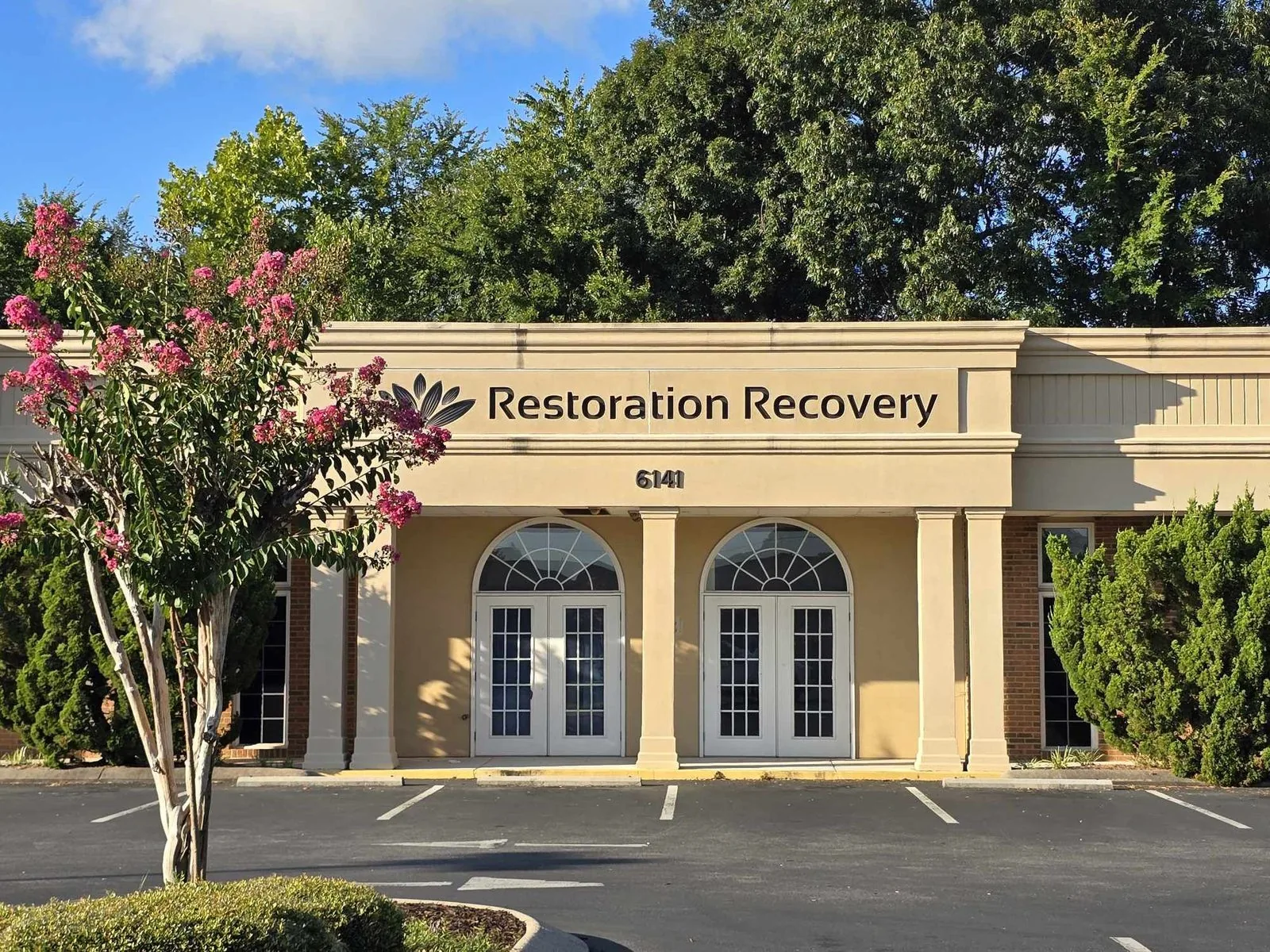
Restoration Recovery Chattanooga clinic near South Pittsburg, TN
From small-town South Pittsburg

The realistic drive from Cedar Avenue to our Shallowford clinic

South Pittsburg is compact. You can walk the full length of Cedar Avenue — past the National Cornbread Festival grounds, the 1930s post office, the old bank buildings, the Princess Theater — in under fifteen minutes. But everything that sits outside the town limits is rural: river bottoms, hollers off 156, the climbing grade up to Jasper, the slow ridges running over toward Alabama. The Lodge Cast Iron foundries anchor the south end of town near the river. The Shelby Rhinehart Bridge puts you over the Tennessee River and onto US-72 toward Alabama in about two minutes. And I-24 is two miles up the road, past the tire shops and the Dollar General on the edge of town. That is the road you will take to Chattanooga.

The route: South Pittsburg to Shallowford Road, Chattanooga

The drive is simple. Out of South Pittsburg, pick up US-72 east or SR-156 to I-24 (the entrance is just past Kimball). Then I-24 east straight through the notch in the mountains — past Monteagle on the plateau, down the long descent into Hamilton County, under Lookout Mountain, past the downtown Chattanooga exits, and off at Exit 184 or Exit 181 depending on traffic. From Exit 184 it is a five-minute run up to 6141 Shallowford Rd. Total door-to-door from downtown South Pittsburg: about 45 minutes in clear traffic, closer to an hour if you hit Chattanooga afternoon rush or weather on the mountain. The entire middle portion of the drive is interstate, which means no traffic lights and no town-center backups once you are past Kimball.

Kimball, Jasper, and the rest of Marion County

If you live in Kimball, Jasper, New Hope, Whitwell, or out toward Monteagle and the Grundy County line, the same route works for you — you just pick up I-24 at whatever exit is closest. Kimball patients shave about ten minutes off the drive versus downtown South Pittsburg; Jasper is similar. Patients coming down out of the Sequatchie Valley from Whitwell or Dunlap often use US-28 south to I-24 and then east; the drive is a few minutes longer but scenic, and it avoids the US-72 bridge if river levels are an issue. From the very west end of the county near the Alabama line, plan on closer to an hour to Shallowford Road.

Why most South Pittsburg patients end up on telehealth after the first visit

A 30-mile, 45-minute drive each way is sustainable for a once-every-four-weeks Sublocade or Vivitrol injection. It is less sustainable as a twice-a-month routine indefinitely, particularly for patients working rotating shifts at Lodge, driving truck, or managing childcare around a small-town school schedule. That is why most of our South Pittsburg patients do exactly one in-person visit for the initial evaluation and then shift most of their follow-up care to secure HIPAA-compliant telehealth. Medication management, counseling check-ins, refills, and behavioral health follow-ups can nearly all be handled from your phone, tablet, or computer. The only visits that have to happen in person are the long-acting buprenorphine injections (Sublocade, Brixadi) or naltrexone injections (Vivitrol) — and those are typically once a month or less.

First visit logistics

Your first visit runs 60 to 120 minutes depending on how the intake flow unfolds — DSM-5 assessment, COWS score if you are being evaluated for opioid use disorder, a counseling intake, and a provider evaluation. In most cases, if Suboxone is clinically appropriate, you leave with a prescription the same day. If you plan to start injection treatment (Sublocade or Brixadi for opioids, Vivitrol for alcohol), the medication is ordered at your first visit and administered at a short follow-up once it arrives. Either way, the first visit is the longest one you will have with us. Most follow-ups are 15 to 30 minutes.

Thinking about the drive differently

A lot of people in South Pittsburg and the surrounding villages have already made this drive dozens of times. It is the route to Hamilton Place, to an area hospital, to the Chattanooga airport, to Costco, to the Lookouts games. For most of our Marion County patients, the first visit is the only one that feels like a separate trip. After that, the appointment cadence fits inside trips they were already making — a Thursday injection on the way back from a Hamilton Place run, or a telehealth follow-up from the Lodge parking lot on a lunch break.

How Treatment Works

Restoration Recovery provides outpatient addiction treatment — no residential stay, no detox facility. You visit our Chattanooga clinic for appointments and go home the same day. Treatment is built around your schedule, not the other way around.

Your first visit typically takes 60 to 120 minutes and follows a four-step flow: intake (DSM-5 assessment + COWS score for opioid use disorder), counseling, a doctor evaluation, and — if clinically appropriate — a same-day Suboxone prescription (Sublocade and Brixadi injections are ordered per-patient and administered at a follow-up visit). Follow-up visits are shorter and can often be done via telehealth from home.

What We Treat

We provide evidence-based treatment for addiction to opioids and opioid-like substances including heroin, fentanyl, oxycodone (OxyContin, Percocet), hydrocodone (Vicodin, Norco), morphine, codeine, tramadol, and prescription painkillers.

We also treat alcohol use disorder, stimulant dependence (cocaine, methamphetamine, Adderall, Ritalin, Vyvanse), benzodiazepine dependence (Xanax, Klonopin, Ativan, Valium), cannabis use disorder, and co-occurring mental health conditions including anxiety, depression, and trauma.

Kratom & 7-Hydroxymitragynine (7-OH) Addiction

Kratom and its concentrated derivative 7-OH are increasingly available and can cause opioid-like physical dependence with severe withdrawal symptoms. Our providers have experience treating kratom and 7-OH dependence with MAT and clinical support tailored to its distinct withdrawal profile. If you are struggling with kratom or 7-OH products, we can help.

Medications We Prescribe

  • Suboxone (buprenorphine/naloxone) — daily film or tablet for opioid use disorder. Reduces cravings and prevents withdrawal so you can function normally.
  • Sublocade (extended-release buprenorphine) — once-monthly injection for patients who prefer not to take daily medication. No pills, no films, no daily decisions.
  • Brixadi (extended-release buprenorphine) — weekly, bi-weekly, or monthly injection for opioid use disorder. Flexible dosing intervals for patients who want a shorter cadence than monthly, or who are still titrating to a maintenance dose.
  • Vivitrol (naltrexone) — once-monthly injection for alcohol use disorder. Blocks the reward pathway that drives compulsive drinking.

Insurance & Cost

We accept most major insurance plans including TennCare, Medicaid, BlueCross BlueShield, Cigna, Aetna, Ambetter, and United Healthcare. Most patients pay little to nothing out of pocket. Verify your coverage or call 423-498-2000 before your first visit.

Why Choose Restoration Recovery

  • CARF accredited (Commission on Accreditation of Rehabilitation Facilities)
  • Licensed in Tennessee and Georgia
  • HIPAA and 42 CFR Part 2 compliant — your treatment is confidential
  • MAT-certified providers
  • Four clinic locations with same-week appointments
  • Telehealth available for follow-up care from home
  • Integrated hepatitis C treatment for enrolled patients
Why South Pittsburg residents come to us

What we see most often from Marion County patients

Lodge and the industrial legacy

Lodge Cast Iron has been operating foundries in South Pittsburg since 1896. The company employs roughly four hundred people in a town of twenty-nine hundred — meaning that if you grew up here, somebody in your family has worked at Lodge, worked at a fab shop or machine shop that fed Lodge, or worked alongside Lodge workers at the grocery store, the elementary school, or the volunteer fire department. The work itself is physically demanding: pouring iron, running mold lines, handling finished castings that can weigh forty pounds each, shifts on concrete all day. Generations of Marion County families have built shoulders, backs, knees, and wrists on that work, and generations of Marion County families have also developed the chronic pain that comes with decades of physical labor. The arc many of our patients describe is the same: a workers' comp injury, a surgery, a short-acting opioid prescription, a taper that did not work, and eventually a dependency that outlasted the original pain. We are a medical clinic. We treat the dependency without judging the origin, and in most cases your underlying pain provider (orthopedics, primary care) can stay in the picture once we have the controlled-substance piece handled.

The small-town stigma problem

Everybody knows everybody in South Pittsburg. The pharmacist knows your mother. Your kid's teacher is married to the deputy who answered your 911 call three years ago. The couple who runs the coffee shop on Cedar Avenue went to high school with your older brother. For a lot of the patients we see from Marion County, that is the single biggest reason they waited years before starting treatment — not the money, not the drive, not the medication itself. The fear of being seen walking into a clinic in town. Our Chattanooga clinic sits 30+ miles east on Shallowford Road, in a commercial corridor near Hamilton Place that is full of patients from Hamilton, Bradley, Marion, Catoosa, and Whitfield counties. The realistic odds of running into someone from your block are close to zero. Your chart is covered by HIPAA and 42 CFR Part 2, the strictest federal privacy standard for substance use treatment — nothing in your record is released to an employer, family member, or outside provider without your written consent. Including if that employer is Lodge, the county, or a school district.

Rural access and the one-visit model

South Pittsburg does not have an in-county MAT provider. The nearest options have historically been Chattanooga to the east or driving all the way down to Huntsville / Scottsboro in Alabama, neither of which is a short trip. Our Chattanooga clinic is the closest of the Tennessee options, and we have deliberately structured our South Pittsburg patient flow around a one-in-person-visit model: the first evaluation happens on Shallowford Road, and then the vast majority of ongoing care happens through secure HIPAA-compliant telehealth. Medication refills, counseling check-ins, behavioral health follow-ups, medication management — all of it can run on your phone, on your home internet, or on the truck's hotspot during a break. The only visits that must happen in person after intake are the long-acting injections (Sublocade, Brixadi, Vivitrol), which are at most once every four weeks. For a lot of our Marion County patients, that works out to roughly one in-person visit per month.

The Kratom / 7-OH conversation in rural Tennessee

Kratom and its concentrated derivative 7-hydroxymitragynine (7-OH) are widely available in rural Tennessee gas stations, smoke shops, and convenience stores — often in packaging that looks more like an energy supplement than a drug. A lot of patients from southeast Tennessee started on kratom precisely because it was legal, cheap, and not something you had to ask a doctor about. Over time, kratom and especially 7-OH products can produce an opioid-like physical dependence with severe withdrawal. If you or someone in your household has been using kratom daily for months or years and is now trying to stop, our providers have experience treating kratom and 7-OH dependence with MAT and clinical support tailored to its specific withdrawal profile. You do not have to stop on your own to walk in our door.

The Narcan-save patient

Marion County EMS carries naloxone. The Tennessee Department of Health has pushed naloxone distribution hard into the southeast region, including into Marion, Grundy, and Sequatchie counties. A lot of our Marion County referrals over the past eighteen months have come from patients who were revived at home, in a parked truck, or at a family member's house by somebody who kept Narcan in the drawer. The 24 hours after a reversal are the most important clinical window we ever work with — the person is awake, physically safe, and usually ready to have the conversation they had been avoiding for months or years. If that happened to you or someone in your home in the last year, a first visit at our clinic does not wait for a "rock bottom" or a period of abstinence. Call 423-498-2000 and we will get you in the same week in most cases.

Family members and caregivers

In a town the size of South Pittsburg, the person calling a clinic is often not the person who will be the patient. We hear from wives, mothers, siblings, and grown children about as often as we hear from the person directly using. You can call on behalf of a family member to ask logistical questions — how insurance works, what the first visit looks like, what medications we prescribe. We cannot confirm or deny whether someone is already a patient without their written consent, but we can walk you through everything else. The number again is 423-498-2000.

Frequently Asked Questions

How far is your Chattanooga clinic from South Pittsburg?

About 45 minutes in light traffic. From downtown South Pittsburg, the route is US-72 east or SR-156 to I-24, then I-24 east across the mountain, through Chattanooga, off at Exit 184 (East Brainerd / Moore Road), and a short run up to 6141 Shallowford Rd, Suite 100. Total drive is roughly 30 miles. The route is almost entirely interstate once you reach Kimball, which means no traffic-light roulette and no town-center backups in the middle portion.

Do I really have to drive to Chattanooga every week?

No. After your first in-person visit, most follow-up care runs through telehealth from home. For patients on once-monthly Sublocade or Vivitrol injections, you come in roughly every four weeks for the injection and do everything else remotely. For stable Suboxone patients, the typical in-person cadence is once a month or less. A 30-mile drive once a month is a very different thing than a 30-mile drive twice a week.

I work at Lodge — will Suboxone affect my ability to work the line?

No. Buprenorphine (the active ingredient in Suboxone, Sublocade, and Brixadi) does not cause impairment the way a short-acting opioid does. Your reflexes, alertness, balance, and decision-making are preserved. Most of our patients work physically demanding manufacturing, trade, truck-driving, healthcare, and construction jobs and do so without any medical restriction. Your medication is covered by HIPAA and 42 CFR Part 2 — your employer, your HR department, and your workers' comp insurer do not see your prescription record.

Will anyone in South Pittsburg know I am in treatment?

No. Treatment is covered by HIPAA and 42 CFR Part 2, the strictest federal privacy standard for substance use care. Nothing in your record is released to a family member, employer, pastor, or other provider without your written consent. Our clinic is 30+ miles away in Chattanooga — the realistic odds of running into a neighbor in our waiting room are near zero. For patients who are particularly concerned, after the first in-person visit the rest of your care can run over telehealth, which means no further trips to Chattanooga are strictly required.

I have a Narcan reversal on my record — will that affect my care or insurance?

No. A prior overdose reversal is not a disqualifier, a red flag, or something your insurance will hold against you for MAT coverage. In fact, it is one of the clearest clinical indications for starting Suboxone or a long-acting buprenorphine injection. Your records are protected by HIPAA and 42 CFR Part 2, which means no employer, family member, or outside provider sees anything without your written consent.

How quickly can I start treatment?

Most Marion County patients are seen within the same week. Call 423-498-2000 or request an appointment online. Many patients begin Suboxone on their first visit (Sublocade and Brixadi injections are ordered during the first visit and administered at a short follow-up). If you are in withdrawal or close to it when you call, we will work to get you in the same week.

What insurance do you accept?

We accept TennCare, Medicaid, BlueCross BlueShield of Tennessee, Cigna, Aetna, Ambetter, United Healthcare, and most major commercial plans — including the employer coverage offered by Lodge Cast Iron and other major Marion County employers. Check your coverage here or call to verify before your first visit.

Do I need to stop using opioids before my first appointment?

You do not need to be completely off opioids before coming in. Your provider will evaluate where you are and guide you through a safe transition onto Suboxone. In most cases, you should be in early withdrawal (usually 12–24 hours since last use of short-acting opioids, longer for long-acting opioids) before your first dose — your provider will explain exactly what to expect and time the first appointment accordingly.

Can I do follow-up appointments from home?

Yes. After your initial in-person evaluation, many follow-up visits can be conducted via secure, HIPAA-compliant telehealth from your phone, tablet, or computer — which is the pattern most Marion County patients end up using to avoid the 30-mile round trip.

Other Restoration Recovery Locations

In addition to our Chattanooga clinic, Restoration Recovery operates three other outpatient locations across Tennessee and Georgia.

  • Cleveland, TN — 2130 Chambliss Avenue NW, Cleveland, TN 37311 (Tue & Thu, 9am–4:30pm)
  • Soddy-Daisy, TN — 210 Walmart Drive, Suite 100, Soddy-Daisy, TN 37379 (Mon & Wed, 9am–4:30pm)
  • Ringgold, GA — 4962 Battlefield Pkwy, Ringgold, GA 30736 (preparing to begin scheduling; wait list open)

View all locations →

Resources

Also serving: Hixson, Red Bank, East Ridge, Signal Mountain

A place for hope & healing

Starting is the
hardest part.
We’ll take it from there.

Same-day appointments available in most cases. Confidential from your first call.