Restoration Recovery outpatient addiction treatment logo
Near Stevenson, AL · Jackson County

Addiction Treatment Near Stevenson, AL

For the roughly 1,900 residents of Stevenson and the wider Jackson County, AL community along the Tennessee River — downtown Stevenson, the Depot district, the US-72 corridor, and the stretch of small mountain communities between the Alabama line and South Pittsburg — Restoration Recovery's Chattanooga clinic is about 45 minutes northeast via US-72 and I-24. Same-week appointments, Suboxone / Sublocade / Brixadi / Vivitrol, and most commercial insurance accepted. Our clinic is licensed in Tennessee; we treat Alabama residents through self-pay or commercial plans (not Alabama Medicaid). If you are already driving to Chattanooga for work, shopping, or medical appointments, a first visit is genuinely on your way.

CARF CARF Accredited Accepting New Patients Same-Week Appointments Commercial & Self-Pay Telehealth Available
The Stevenson Picture

What recovery looks like from Jackson County, AL

Stevenson sits in the far northeast corner of Alabama — tucked against the Tennessee River at the foot of the Cumberland Mountains, ten minutes from the Tennessee state line, a short drive from South Pittsburg, and well inside the Chattanooga-Cleveland-Dalton Combined Statistical Area. A lot of people here already run their week on the same roads the clinic does. The grocery run, the hospital visit, the kids' ballgame across the river, the commute — most of it crosses US-72 east through South Pittsburg, onto I-24, and into Chattanooga. If you are wondering whether outpatient MAT (medication-assisted treatment) is realistic from a small Alabama railroad town, the honest answer is that it is — and the route is one you probably already drive.

The patients we see from the Stevenson / Bridgeport / Scottsboro side of the state line are not a stereotype. They are millwrights and welders, warehouse workers and line cooks, hospital techs, school staff, TVA contractors, and retirees from the old railroad and manufacturing economy that built this corner of Alabama. A large share started on a legitimate prescription — after a back injury on a job site, a wreck out on US-72, a shoulder surgery, a workplace accident at one of the industrial sites along the river — and got stuck when the prescription ended. Some tapered poorly. Some were cut off abruptly. Some rationed a script and ran out early. Almost all held jobs the entire time. That is the population outpatient Suboxone is designed for.

Alabama fentanyl overdose deaths

Annual counts, 2020 – 2024

428 2020
830 2021
266 Jan–Oct 2024 confirmed, YTD

Source: Alabama Opioid Overdose and Addiction Council, 2024 Annual Report (ADMH / ADPH).

Alabama total overdose deaths

12-month trend, CDC provisional data

1,492 2022
~1,688 Jul 2023
~1,380 Jul 2024 ↓ 18.24% YoY

Source: CDC NCHS Provisional Drug Overdose Death Counts, July 2024.

Why the Alabama numbers matter in Stevenson

Alabama saw a genuine, measurable drop in overdose deaths over the twelve months ending in July 2024 — a decline of roughly 18% according to CDC provisional data. That is the state's first real turn downward since the pre-fentanyl era, and it matches the trend on the Tennessee side of the border where Hamilton County fentanyl deaths fell from 77 in 2022 to 42 in 2024. The Stevenson patient sitting in the clinic does not need the whole state trend explained — they need to know their odds are better now than they were two years ago, and that the thing driving the improvement is the same thing they are here to ask about.

Rural Alabama, though, has been slower to benefit than the metros. A widely cited analysis of EMS overdose calls found the overdose burden is about 45% higher in rural counties than urban counties, and Jackson County, AL is listed as one of the priority counties in Project FREEDOM — the state's rural first-responder naloxone initiative. The practical read-through for Stevenson: fentanyl is in the supply here, Narcan is in circulation, and the gap between "revived in a driveway" and "sitting across from a provider" is narrower now than it has ever been.

If you or someone in your household has been revived with Narcan in the last twelve months — or has narrowly avoided it — a first appointment with us does not require a period of abstinence. We do not require you to have tried anything else first.

Nearest Location · ~45 min from Stevenson

Chattanooga Clinic

Address6141 Shallowford Rd, Suite 100
Chattanooga, TN 37421
HoursMonday – Friday · 9:00 am – 4:30 pm
Fax423-498-2001
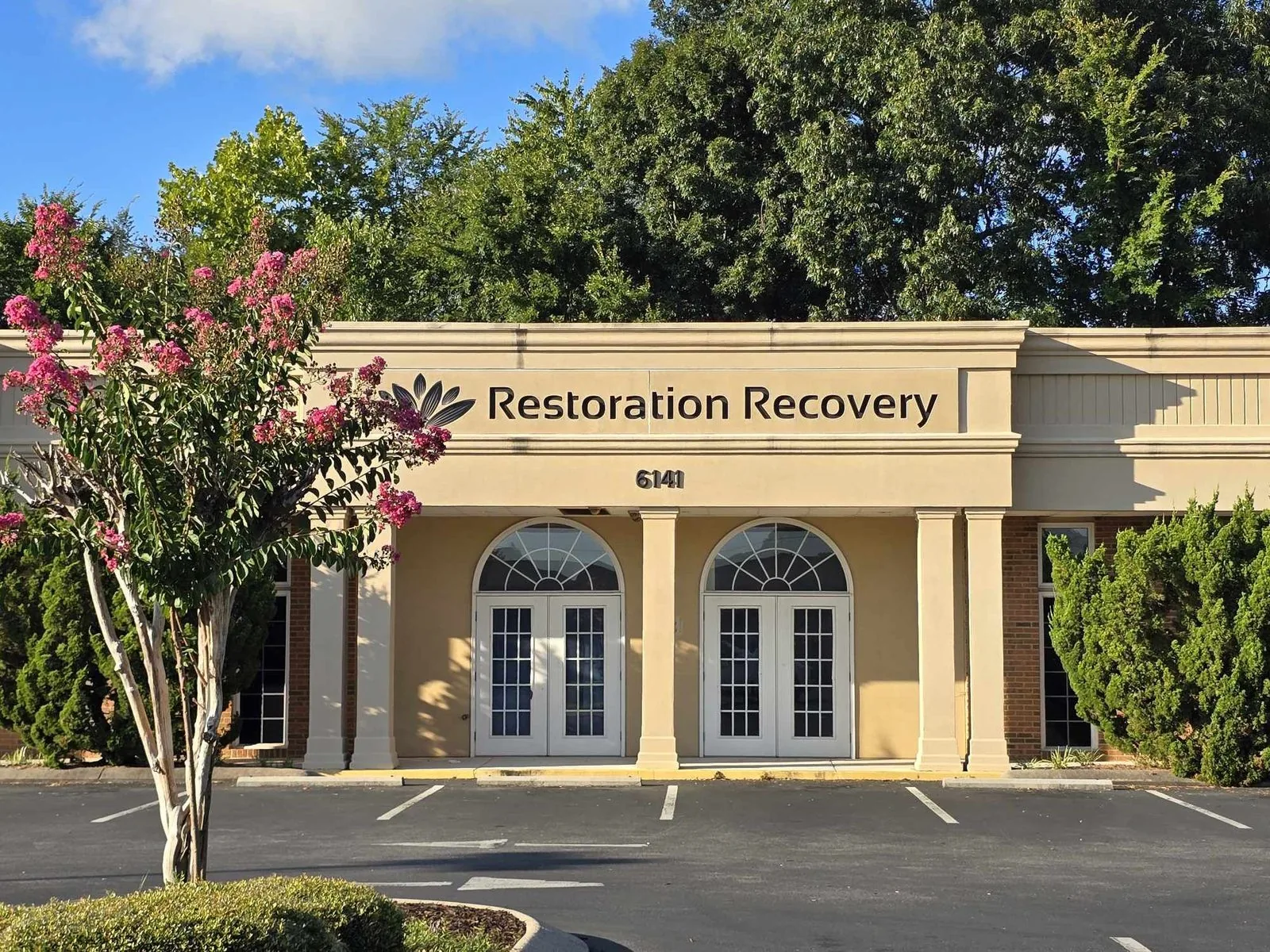
Restoration Recovery Chattanooga clinic near Stevenson, AL
From your Stevenson area

The realistic drive from downtown Stevenson to our Shallowford clinic

Stevenson is small — only about 1,900 people, concentrated along the old rail corridor around the Stevenson Depot and spreading out onto the farms and subdivisions that climb the Cumberland foothills. How you get to Chattanooga depends a little on where you live in town or in the wider Jackson County community, but almost everyone ends up on US-72 east for the first leg and I-24 east for the second leg. The Chattanooga clinic sits just off I-24 and Shallowford Road, so the drive is surprisingly simple once you are on it. Plan on 42 to 48 minutes outside rush hour.

Downtown Stevenson / Depot district (around Main Street and the rail junction)

If you live in the historic center of town — Main Street, Kentucky Avenue, the blocks around the Stevenson Railroad Depot Museum, or the neighborhoods backing up to the old Memphis & Charleston rail line — US-72 is right at your door. Pull onto US-72 east and stay on it for about 17 miles across the Tennessee state line to South Pittsburg, then follow the signs to I-24 east. From there it is a straight shot to Exit 184 (Moore Road), south to Shallowford Road. Figure 45 minutes on a clear day. The US-72 stretch between Stevenson and the Tennessee line is four-laned, which keeps the first half of the drive moving.

Jackson County farm communities (Widows Creek, Pleasant Groves, Mud Creek)

If you live out in the farm country north or west of Stevenson — the Widows Creek / TVA substation area, Pleasant Groves, the Mud Creek valley, or any of the small communities that feed onto Highway 117 or County Road 69 — your first few minutes are on two-lane county roads before you pick up US-72 east in town. That adds maybe five to ten minutes to the front end. Total drive time from most of the Jackson County farm communities runs 50 to 60 minutes. Not fast, but consistent: no big-city traffic, no lane changes, no interchange puzzles.

Bridgeport / Hollywood side (west of Stevenson, along US-72)

If you live west of Stevenson — Bridgeport, Hollywood, the blocks along Alabama Highway 117 south of US-72 — you are a little farther out but your route is identical after you hit US-72. Expect 50 to 55 minutes. Several of our Jackson County, AL patients from this side of the county already commute to Chattanooga or South Pittsburg for work, and the clinic visit fits onto the existing trip.

Scottsboro / Section area (south Jackson County)

If you live down in Scottsboro or Section — the southern end of Jackson County, closer to Sand Mountain — you are looking at about an hour to 75 minutes, depending on where you pick up US-72 and how traffic is through Scottsboro. For a patient on a monthly Sublocade or Brixadi injection schedule, that is a once-a-month in-person trip with telehealth filling everything in between. For someone just starting, the first 2–3 visits will be on-site, then the cadence drops.

Already commuting to Chattanooga?

A sizable share of Jackson County workers cross into Tennessee every day — to the Volkswagen assembly plant in Chattanooga, the Amazon fulfillment sites, the hospitals, the downtown office towers, or the service and construction trades spread across Hamilton County. If you are one of them, the clinic is literally on your path: Exit 184 sits on your commute home, and a 9 am appointment works before a late shift while a 4 pm works after a day shift. Several of our Stevenson-area patients do one in-person visit a month and run everything else on telehealth from home or from a parked truck at a rest stop on the way back.

About the cross-state dynamic (important)

Stevenson is in Alabama. Our clinic is in Tennessee. That matters for insurance, not for whether you can be treated here. Tennessee law does not require you to be a Tennessee resident to receive care at a Tennessee-licensed clinic, and we treat patients from Jackson County, AL regularly. The constraint is how you pay: Alabama Medicaid typically does not cover services at our clinic (more on that below), while most commercial insurance does. If you drive to Chattanooga already for employer-sponsored healthcare, chances are the plan that covers your primary-care visits also covers MAT with us. Call us with your insurance card before the first visit and we will tell you honestly what will and will not work.

First visit timing

Your first in-person visit runs 60 to 120 minutes depending on the intake flow — so a long-morning trip, a half-day off, or a 9 am pre-shift slot is the easiest fit. Follow-up visits are much shorter (usually 15 to 30 minutes) and most qualify for telehealth after the first in-person evaluation. For a Stevenson patient, that is the difference between a 90-mile round trip every week and a 90-mile round trip every four weeks.

How Treatment Works

Restoration Recovery provides outpatient addiction treatment — no residential stay, no detox facility. You visit our Chattanooga clinic for appointments and go home the same day. Treatment is built around your schedule, not the other way around.

Your first visit typically takes 60 to 120 minutes and follows a four-step flow: intake (DSM-5 assessment + COWS score for opioid use disorder), counseling, a doctor evaluation, and — if clinically appropriate — a same-day Suboxone prescription (Sublocade and Brixadi injections are ordered per-patient and administered at a follow-up visit). Follow-up visits are shorter and can often be done via telehealth from home.

What We Treat

We provide evidence-based treatment for addiction to opioids and opioid-like substances including heroin, fentanyl, oxycodone (OxyContin, Percocet), hydrocodone (Vicodin, Norco), morphine, codeine, tramadol, and prescription painkillers.

We also treat alcohol use disorder, stimulant dependence (cocaine, methamphetamine, Adderall, Ritalin, Vyvanse), benzodiazepine dependence (Xanax, Klonopin, Ativan, Valium), cannabis use disorder, and co-occurring mental health conditions including anxiety, depression, and trauma.

Kratom & 7-Hydroxymitragynine (7-OH) Addiction

Kratom and its concentrated derivative 7-OH are increasingly available in gas stations and smoke shops across north Alabama and can cause opioid-like physical dependence with severe withdrawal symptoms. Our providers have experience treating kratom and 7-OH dependence with MAT and clinical support tailored to its distinct withdrawal profile. If you are struggling with kratom or 7-OH products, we can help.

Medications We Prescribe

  • Suboxone (buprenorphine/naloxone) — daily film or tablet for opioid use disorder. Reduces cravings and prevents withdrawal so you can function normally.
  • Sublocade (extended-release buprenorphine) — once-monthly injection for patients who prefer not to take daily medication. Well-suited to patients driving in from Alabama who want to minimize trips.
  • Brixadi (extended-release buprenorphine) — weekly, bi-weekly, or monthly injection for opioid use disorder. Flexible dosing intervals for patients who want a shorter cadence than monthly, or who are still titrating to a maintenance dose.
  • Vivitrol (naltrexone) — once-monthly injection for alcohol use disorder. Blocks the reward pathway that drives compulsive drinking.

Insurance & Cost (Alabama residents)

For Alabama residents reaching our Tennessee clinic, the working options are: most commercial plans (BlueCross BlueShield of Alabama, Cigna, Aetna, Ambetter, United Healthcare, and most employer plans that follow you across state lines), Medicare for patients 65 and older, and self-pay. Alabama Medicaid typically does not cover services at our clinic (see the FAQ and the "Why Stevenson residents come to us" section below for detail). Verify your coverage or call 423-498-2000 before your first visit — we will tell you specifically what your plan covers.

Why Choose Restoration Recovery

  • CARF accredited (Commission on Accreditation of Rehabilitation Facilities)
  • Licensed in Tennessee and Georgia
  • HIPAA and 42 CFR Part 2 compliant — your treatment is confidential
  • MAT-certified providers
  • Four clinic locations with same-week appointments
  • Telehealth available for follow-up care from home — particularly valuable for Alabama patients driving in
  • Integrated hepatitis C treatment for enrolled patients
Why Stevenson residents come to us

What we see most often from Jackson County, AL patients

The already-commuting-to-Chattanooga crowd

Stevenson's economic center of gravity tips north. The city sits inside the Chattanooga-Cleveland-Dalton Combined Statistical Area, which is a bureaucratic way of saying that a sizable number of working-age Jackson County residents cross the state line for work every day. The Volkswagen plant, the Amazon fulfillment sites, the hospital systems, the trades and construction economy along I-75 and I-24, and the TVA and utility work that spans both sides of the river — those jobs draw workers out of Stevenson, Bridgeport, and South Pittsburg in both directions. If you are already driving US-72 east five days a week, our clinic is on your way home, not a detour. A standing 4 pm Tuesday slot after a day shift, or a 9 am before a swing shift, works cleanly for the commuter patient.

The railroad-town legacy and an aging workforce

Stevenson's economy was built on the rail junction — the town was the convergence point for the Memphis & Charleston and Nashville & Chattanooga lines before the Civil War and spent a hundred years as a division point for freight crews. Some of that labor heritage is still visible in the workforce: railroad retirees, the successor industries along the river, the freight warehouses, the trades. A lot of older workers in this community had legitimate prescriptions for oxycodone or hydrocodone after an injury on the job or a surgery, and ended up physically dependent when the script ran out. The clinical picture is almost always simpler than the story. Buprenorphine at the right dose handles the withdrawal and the craving and lets the pain conversation resume with the original provider — who in many cases is relieved to have the controlled-substance piece handled by a specialty clinic.

The Alabama-Medicaid problem (and the practical workaround)

This is the one that keeps most Stevenson residents from reaching MAT sooner, so we want to say it plainly: Alabama Medicaid will not usually cover services at our clinic. Alabama Medicaid covers out-of-state services only in emergencies, or when a provider within 30 miles of the Alabama border is separately enrolled with Alabama Medicaid and the referring provider files an Out-of-State Service Request. We are not enrolled with Alabama Medicaid. So if Alabama Medicaid is your only coverage, we will be upfront with you: the path forward with us is either self-pay or waiting until a covered option opens up on the Alabama side. We can help you think that through on a first call. On the other hand: if you have a commercial plan (BlueCross BlueShield of Alabama, Cigna, Aetna, Ambetter, United Healthcare, an employer plan from a Chattanooga-area job, Medicare for age-65+, or any major commercial insurer), those typically follow you across state lines and cover care here the same way they cover care at any in-network provider. Most Jackson County, AL patients we see are on commercial plans tied to an employer on the Tennessee side, or are paying cash for a manageable flat rate until something else opens up.

The TennCare-equivalent confusion

We want to head off a common mix-up: TennCare is Tennessee's Medicaid program, and Alabama Medicaid is a separate state program with separate MCOs, separate benefits, and a separate provider network. The two do not share enrollment. Restoration Recovery accepts TennCare (and participates with BlueCare, Amerigroup Wellpoint, UHC Community Plan on the Tennessee side), but a Stevenson resident whose only insurance is Alabama Medicaid is not a TennCare member and cannot bill through us as one. Some patients assume all state Medicaid programs work everywhere; they do not. This is a big reason Alabama residents who want MAT across the line end up on self-pay or commercial plans — the bureaucratic bridge between Alabama Medicaid and a Tennessee provider simply is not there.

The small-town privacy concern

Stevenson is tight-knit. About 1,900 people live inside city limits. A common reason our Jackson County patients give for waiting too long to start treatment is that they did not want to run into a neighbor in a waiting room — or risk having word travel back to church, family, or a former employer. Our Chattanooga clinic sits 45 minutes across the state line and over a mountain range. Your entire chart is covered by HIPAA and 42 CFR Part 2, the strictest federal privacy standard for substance use treatment; nothing in your record can be released to an employer, a family member, or another provider without your written consent. And crucially: the geographic separation itself does work. The person you sit behind at church is not in our waiting room.

The rural-access pattern: Sublocade, Brixadi, and telehealth

Almost everyone who drives 45 minutes to a weekly or twice-weekly Suboxone appointment eventually asks whether there is a way to come less often. The answer is yes — for most patients on stable doses, a Sublocade or Brixadi monthly injection replaces the daily film entirely, dropping the in-person cadence to roughly once a month for the injection plus short telehealth check-ins in between. For Stevenson patients, this is the difference between a 90-mile round trip every week and a 90-mile round trip every four weeks. Several of our Jackson County patients have moved to this pattern after the first 60 to 90 days of stabilization and have not missed a dose since.

The Narcan-save patient

Jackson County, AL is one of the priority counties in Alabama's rural Project FREEDOM initiative, which has put more naloxone into the hands of local EMS and first responders across northeast Alabama. A growing share of our referrals over the past 18 months comes from patients who were revived at home or in a public place and were handed a Narcan refill plus a list of local treatment options on the way out of the ER. The 24 hours after a reversal are the most important window we work with — the person is awake, physically safe, and usually terrified enough to want a different outcome. A first visit with us does not wait for a "rock bottom" or a period of abstinence. If that happened to you or someone in your home in the last year, call us and we will work to fit you in that week.

Frequently Asked Questions

Does Alabama Medicaid cover treatment at your Tennessee clinic?

Usually no, and we want to be straightforward about it. Alabama Medicaid only covers out-of-state services in emergencies, or when an out-of-state provider within 30 miles of the Alabama border is specifically enrolled with Alabama Medicaid and the referring Alabama provider files an Out-of-State Service Request form. Restoration Recovery is not enrolled with Alabama Medicaid. If Alabama Medicaid is your only coverage, the practical paths are self-pay with us (ask us about the cash rate), or waiting for a covered in-Alabama option. If you have any commercial plan, Medicare, or a Tennessee-employer plan on top of or instead of Medicaid, that usually works here. Call 423-498-2000 and we will check specifically before you drive.

Can an Alabama resident be treated at a Tennessee clinic at all?

Yes. Tennessee law does not require you to be a Tennessee resident to receive care at a Tennessee-licensed clinic. We treat patients from Stevenson, Bridgeport, Scottsboro, and the wider northeast Alabama region regularly. The only practical constraints are (1) the drive, and (2) how you pay. Neither is a legal block on treatment itself.

How far is your Chattanooga clinic from Stevenson?

About 45 minutes and 45 miles. From downtown Stevenson, the standard route is US-72 east across the Tennessee state line to South Pittsburg, then I-24 east into Chattanooga, off at Exit 184 (Moore Road), south to Shallowford Road. The US-72 stretch between Stevenson and the Tennessee line is four-laned, which keeps the front end of the trip moving. Outside of morning or afternoon rush on I-24 at the Ridge Cut, the drive runs 42 to 48 minutes.

What insurance do you actually accept for Alabama residents?

For Alabama residents specifically, the working options are most commercial plans (BlueCross BlueShield of Alabama, Cigna, Aetna, Ambetter, United Healthcare, and most employer plans from Tennessee or north Alabama employers), Medicare for patients 65 and older, and self-pay. We also accept TennCare for Tennessee residents, but a Stevenson resident with only Alabama Medicaid cannot bill through TennCare. See our full insurance page or call to verify before your first visit.

I have a Narcan reversal on my record — will that affect my care or insurance?

No. A prior overdose reversal is not a disqualifier, a red flag, or something your insurance will hold against you for MAT coverage. It is one of the clearest clinical indications for starting Suboxone or a long-acting buprenorphine injection. Your records are protected by HIPAA and 42 CFR Part 2, which means no employer, family member, or outside provider sees anything without your written consent.

How quickly can I start treatment?

Most Jackson County, AL patients are seen within the same week. Call 423-498-2000 or request an appointment online. Many patients begin Suboxone on their first visit; Sublocade and Brixadi injections are ordered during the first visit and administered at a short follow-up. If you are in withdrawal or close to it when you call, we will work to get you in the same week.

I live in a small town — will my treatment be confidential?

Yes. All treatment is protected by HIPAA and 42 CFR Part 2 — the strictest federal privacy standard for substance use treatment. Records cannot be shared without your written consent, including with family, employers, or other providers. For Stevenson patients concerned about running into a neighbor, the clinic is across the state line in Tennessee and 45 minutes away; the geographic separation itself is part of why people drive here rather than seeking care locally.

Can I do follow-up appointments from home?

Yes, and for a Stevenson patient this is usually the single most valuable piece of the arrangement. After your initial in-person evaluation, many follow-up visits can be conducted via secure, HIPAA-compliant telehealth from your phone, tablet, or computer. Combined with monthly Sublocade or Brixadi, you can often reduce the in-person trip to once every four weeks.

Do I need to stop using opioids before my first appointment?

You do not need to be completely off opioids before coming in. Your provider will evaluate where you are and guide you through a safe transition onto Suboxone. In most cases, you should be in early withdrawal (usually 12–24 hours since last use of short-acting opioids, longer for methadone or fentanyl) before your first dose — your provider will explain exactly what to expect and time the first appointment accordingly.

Other Restoration Recovery Locations

In addition to our Chattanooga clinic, Restoration Recovery operates three other outpatient locations across Tennessee and Georgia.

  • Cleveland, TN — 2130 Chambliss Avenue NW, Cleveland, TN 37311 (Tue & Thu, 9am–4:30pm)
  • Soddy-Daisy, TN — 210 Walmart Drive, Suite 100, Soddy-Daisy, TN 37379 (Mon & Wed, 9am–4:30pm)
  • Ringgold, GA — 4962 Battlefield Pkwy, Ringgold, GA 30736 (Fri, 9am–4:30pm)

View all locations →

Resources

Also serving: Hixson, Red Bank, East Ridge, Signal Mountain

A place for hope & healing

Starting is the
hardest part.
We’ll take it from there.

Same-day appointments available in most cases. Confidential from your first call.